
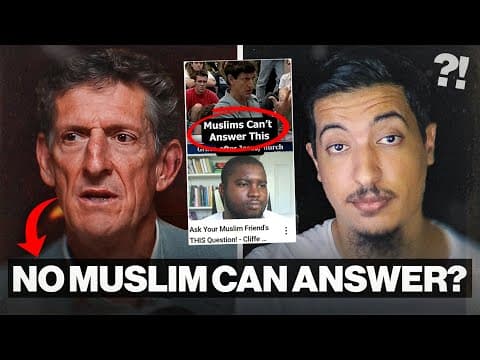
In a recent video, a Christian challenges Muslims to answer a question regarding the authenticity of the Gospels. This blog post analyzes the arguments presented, addressing misconceptions about the Quran and the Gospels, and emphasizes the importance of understanding prophethood and revelation in Islam.
In a recent video, a Christian claims that no Muslim can answer a specific question regarding the authenticity of the Gospels. This blog post aims to dissect the arguments presented in the video, clarify misconceptions about Islamic beliefs, and emphasize the significance of understanding prophethood and revelation in Islam.
The video begins with a challenge directed at Muslims, suggesting that they cannot provide satisfactory answers to questions about the Gospels of Matthew, Mark, Luke, and John. The speaker, a Muslim, responds to this challenge, asserting that the premise itself is flawed.
The Christian speaker asserts that Muslims often claim the Gospels are inaccurate or have been altered. He then poses the question: "Where are the unperverted Gospels?" This question implies that Muslims should provide evidence of original, unaltered texts. However, the Muslim response highlights several key points:
Understanding of the Gospels: Muslims believe in the original Gospel of Jesus but do not consider the current Gospels as authoritative. The speaker argues that the Gospels were not directly revealed by God but were written by individuals who were not prophets.
The Nature of Prophethood: The speaker emphasizes that the validity of a prophet does not depend on their temporal proximity to previous prophets. For instance, the argument that Prophet Muhammad, who lived 500 years after Jesus, should be rejected because he did not meet Jesus is flawed. Many prophets spoke of events long before their time, yet their messages are accepted.
The speaker challenges the Christian assertion of the Gospels' authenticity by pointing out contradictions within them. For example, he raises the question of who carried the cross during the crucifixion of Jesus, citing discrepancies between the Gospels of Matthew, Mark, Luke, and John. This inconsistency raises doubts about the reliability of these texts as historical accounts.
Who Carried the Cross?: The Gospels of Matthew, Mark, and Luke agree that Simon of Cyrene carried the cross, while John states that Jesus carried it himself. This contradiction calls into question the reliability of the Gospels as eyewitness accounts.
Authorship of the Gospels: The speaker argues that the Gospels were not written by eyewitnesses. For instance, Mark was not a disciple of Jesus, and Matthew is said to have relied on Mark's account. Luke explicitly states that he is compiling accounts from those who were eyewitnesses, indicating that he himself was not one.
The speaker asserts that the Quran provides a more accurate representation of Jesus than the Gospels. He argues that the Quran is a direct revelation from God, while the Gospels are human interpretations that have been altered over time. This claim is rooted in the belief that the Quran preserves the true message of Jesus and other prophets.
The speaker emphasizes that the authority of any prophet comes from their direct revelation from God. This principle applies to all prophets, including Jesus and Muhammad. The Quran, as the final revelation, is viewed as the ultimate source of truth regarding all prophets.
The discussion highlights the complexities of interfaith dialogue, particularly regarding the authenticity of religious texts. The Muslim speaker challenges the Christian assertion that Muslims cannot answer questions about the Gospels, providing a robust defense of Islamic beliefs regarding prophethood and revelation.
In conclusion, the speaker calls for mutual respect and understanding among followers of different faiths, emphasizing that Muslims honor all prophets and their messages. The hope is that through dialogue, individuals may find common ground and a deeper understanding of each other's beliefs.
As the speaker concludes, may Allah guide all towards the truth, and may interfaith discussions foster respect and understanding among diverse religious communities.



















