
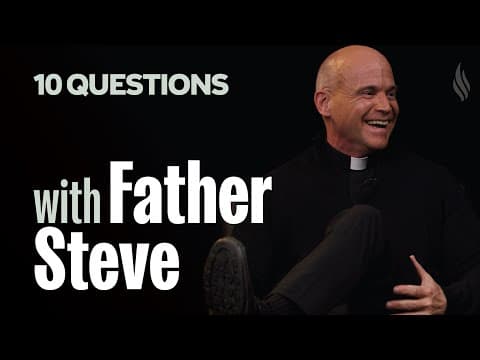
Fr. Steve Grunow discusses the historical context of the Church's challenges, the significance of mysticism, the impact of social media, and the importance of authentic spirituality in contemporary Catholicism.
In a recent episode of "10 Questions," Matt Petrusic interviews Father Steve Grunow, the executive producer and CEO of Word on Fire. The discussion delves into the Church's historical challenges, the influence of mysticism, the role of social media, and the essence of spirituality in today's world. This blog post summarizes the key insights shared by Fr. Grunow.
Fr. Grunow asserts that the Church has always existed in a hostile environment. He argues that while the nature of hostility may change, the Church's experience of it is not unique to our time. He emphasizes that the Church has faced challenges throughout history, and the current secularism and technological advancements are continuations of past struggles.
When asked if the Church is experiencing a uniquely dark period of scandal and dysfunction, Fr. Grunow responds negatively. He points out that historical reference points are essential for understanding the current situation. The Church has faced corruption and scandal before, and while the impact may feel significant now, it is not unprecedented.
Fr. Grunow highlights the profound influence of St. John of the Cross on his spiritual journey, emphasizing the importance of deep mysticism in understanding the faith. He believes that contemporary Catholicism could benefit from a greater emphasis on mysticism, which transcends mere propositional beliefs and engages with the deeper aspects of faith.
René Girard's insights on mimesis and the origins of religion in violence also resonate with Fr. Grunow. He believes Girard's work illuminates the complexities of human behavior and the need for a deeper understanding of the Gospel.
Fr. Grunow discusses the challenges faced by Catholic social media culture, suggesting that it often struggles to bear the weight of the Church's tradition. While it can articulate Catholic teachings, it frequently fails to demonstrate them as a lived reality. He views the current state of Catholic social media as a toss-up between being a force for good or less than good.
Fr. Grunow argues that social media can facilitate mob mentality and scapegoating, echoing Girard's theories. He believes that Catholics must be aware of these dynamics and strive for a more authentic engagement with the faith in the digital space.
When discussing the aesthetic preferences in Catholic art and architecture, Fr. Grunow asserts that beauty should be the guiding principle rather than a specific style. He emphasizes that beauty transcends historical and generational preferences, and the Church should focus on manifesting the true, the good, and the beautiful in all forms of expression.
Fr. Grunow reflects on the Church's historical involvement in politics, noting that while it has played a significant role, there are risks associated with such engagement. He cautions against naively idealizing the Church's political influence, reminding us that the political landscape is ever-changing.
He argues that the Church should articulate moral principles but acknowledges that the responsibility lies with the laity to internalize these teachings and apply them in the political arena. Fr. Grunow emphasizes that the Church's contributions to Western civilization are foundational, particularly regarding human dignity and ethical considerations.
Fr. Grunow identifies a vocation crisis in the West, linking it to a broader crisis in families and a lack of understanding of life's purpose. He suggests that the demographic reality of fewer children being born contributes significantly to the decline in vocations.
He argues that a vibrant faith life, characterized by charity and authentic relationships with Christ, is essential for inspiring vocations. Fr. Grunow believes that the Church must focus on living out the Gospel in a way that invites others to consider a life of service.
Fr. Grunow asserts the reality of the devil and malign spirits, emphasizing that their influence is often internal rather than external. He warns against projecting the concept of evil onto societal issues without recognizing the personal responsibility each individual holds.
He argues that spirituality, despite its secularization, remains a vital aspect of the Christian experience. Fr. Grunow encourages a re-engagement with authentic spirituality that reflects the legacy of Christ and the Church.
Fr. Steve Grunow's insights provide a profound reflection on the Church's role in a contemporary world filled with challenges. By emphasizing the importance of mysticism, the impact of social media, and the need for authentic spirituality, he invites Catholics to engage deeply with their faith and contribute positively to society. The conversation serves as a reminder that the Church's mission remains vital, even in the face of adversity.



















