
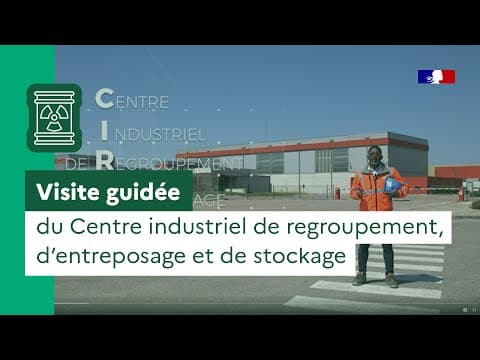
The Cires facility in the Aube region of France is dedicated to the surface storage of very low-level radioactive waste, primarily from nuclear maintenance and decommissioning. This post details the facility's operations, safety measures, and environmental monitoring practices.
Welcome to the Aube department in France, home to one of the two industrial centers operated by the National Agency for Radioactive Waste Management (Andra). Today, we will explore the Cires, which stands for the Industrial Center for Gathering, Storage, and Storage of Radioactive Waste. This facility is dedicated to the surface storage of very low-level radioactive waste, primarily generated from the maintenance and decommissioning of nuclear installations.
The waste stored at Cires consists mainly of concrete, rubble, and scrap metal. Since its operation began in 2003, the facility has been authorized to gather, store, sort, and treat radioactive waste from non-nuclear activities as well.
Upon arrival at the center, transport containers undergo several checks. Initially, an administrative delivery control is performed, followed by radiological checks to ensure there is no contamination, meaning no presence of radioactive dust. Additionally, the levels of radiation emitted from the waste inside the containers are verified.
The waste packages are sampled upon opening the containers to ensure compliance with Andra's requirements and current regulations. On average, the facility receives about twenty shipments per day, with the handling process varying based on the nature of the waste.
The facility includes a building dedicated to specific treatments before storage. This building is equipped with two presses that reduce the volume of waste, including light scrap metal and plastics, as well as a solidification unit for liquid waste. It is important to note that the storage of untreated waste is not permitted.
Inside the facility, we find a storage cell that is currently empty. This cell is excavated in the Argiles de l'Aube at a depth of 8.5 meters, measuring 174 meters in length and 26 meters in width, with a storage capacity of approximately 30,000 cubic meters.
Before storage begins, the bottom and sides of the cell are lined with a 2 mm thick high-density polyethylene synthetic membrane, protected by a geotextile. A drainage system is installed at the bottom of the cell, connected to two observation wells constructed as the cell fills. This system allows for monitoring of infiltration and pumping of water if necessary.
All construction and storage activities are conducted under a protective roof structure to shield them from the elements. During the operational phase, waste packages are stored in layers, with the voids between them filled with sand. Ultimately, there can be over 14 meters of waste stacked within the cell, with 8.5 meters below ground level and 6 meters above.
The waste is transported in pre-packaged forms, primarily in big bags or metal containers, which facilitates handling. Once a cell is filled, it is covered with a temporary protective layer made of a high-density polyethylene membrane thermally welded to the cell's lining.
When several adjacent cells are filled and covered, work can commence on the installation of a permanent cover. This cover consists of a series of natural materials separated by a geocomposite membrane to prevent mixing. Each layer of material serves a specific role in ensuring the impermeability of the cell and managing rainwater drainage.
Andra is committed to ensuring that the activities at Cires have the least possible impact on humans and the environment. To this end, over 1,500 radiological analyses are conducted annually on the site and its surroundings, including monitoring of stream waters, groundwater, sediments, and atmospheric emissions. This surveillance will continue for thirty years after the facility ceases operations.
This concludes our visit to the Cires facility. For more information, you can visit the Andra website. The Cires plays a crucial role in the management of radioactive waste in France, ensuring safety and environmental protection through rigorous monitoring and innovative storage solutions.



















