
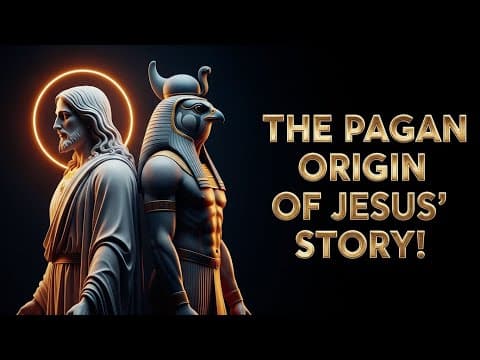
This article examines the parallels between the life of Jesus and various pagan deities, including Horus, Mithra, and others. It discusses the similarities in their narratives, the historical context of early Christianity, and the implications of these comparisons on the understanding of Christian origins.
The narrative of Jesus Christ has been a cornerstone of Christian belief for centuries. However, a growing body of scholarship suggests that elements of his story may have been influenced by earlier pagan deities. This article delves into the parallels between Jesus and figures such as Horus, Mithra, Dionysus, Attis, and Krishna, exploring the implications of these similarities on the understanding of Christian origins.
The Egyptian god Horus, worshipped over 3,000 years before the New Testament was written, shares striking similarities with the life of Jesus. Horus was born of a virgin, heralded by a star, and had twelve companions. His life included miracles, betrayal, death, and resurrection after three days in darkness. Scholars have documented these parallels extensively, noting that the church has historically avoided discussing them.
Mithra, a deity from Persian mythology, also presents significant parallels to Jesus. By the time early Christians were writing their gospels, Mithraism was well-established in the Roman Empire.
Dionysus, the Greek god of wine, also shares a narrative structure with Jesus:
Attis, worshipped in Phrygia, presents even closer parallels:
Krishna, a major figure in Hinduism, also exhibits similarities:
The recurring themes across these figures suggest a mythological template that transcends individual cultures. The elements of a divine child born of a virgin, a miraculous ministry, sacrificial death, and resurrection are not isolated incidents but part of a broader narrative framework that existed long before the New Testament.
The early church emerged in a world already familiar with these mythological narratives. The writings of Paul, the earliest Christian texts, focus on the death and resurrection of Jesus as cosmic events rather than biographical accounts. This indicates that the narrative of Jesus was constructed within a pre-existing mythological context.
In 325 CE, the Council of Nicaea, convened by Emperor Constantine, played a crucial role in shaping Christian doctrine. The council aimed to unify the diverse beliefs within Christianity and canonize texts that aligned with the established mythological narrative. This led to the suppression of alternative accounts, such as the Gospel of Thomas and the Gospel of Mary Magdalene, which did not fit the emerging orthodoxy.
The early church systematically suppressed pagan traditions and alternative Christian texts that did not conform to the new narrative. Pagan temples were repurposed as churches, and Christian feast days were aligned with existing pagan festivals. This strategic blending aimed to create a seamless transition for converts, ensuring that the new faith felt familiar.
The exploration of these parallels raises significant questions about the origins of the Christian narrative. The similarities between Jesus and earlier pagan deities suggest that the story of Jesus was not entirely unique but rather a reworking of existing mythological themes. Understanding this context is crucial for those seeking to grasp the historical and cultural foundations of Christianity. The narrative of Jesus, while central to the faith, is part of a larger tapestry of human storytelling that spans cultures and centuries.



















