
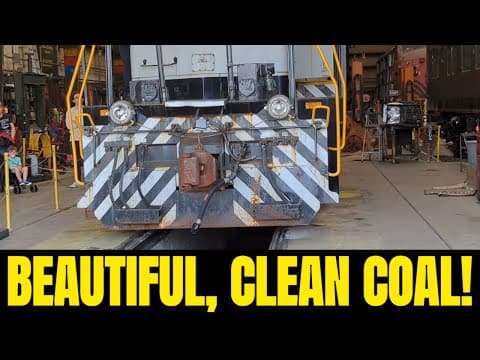
This blog post explores a visit to a train museum in Chattanooga, Tennessee, where the cleanliness of coal-powered trains is examined through particle count measurements. The findings suggest that coal trains can be cleaner than some modern restaurants, challenging common perceptions about coal's environmental impact.
In a fascinating exploration of coal's environmental impact, a visit to a train museum in Chattanooga, Tennessee, reveals surprising insights about the cleanliness of coal-powered trains. This blog post recounts the journey, focusing on particle count measurements taken near a historic coal locomotive, and compares these findings to modern dining establishments.
The adventure begins in Chattanooga, a city with a rich railroad history. The museum showcases vintage train cars, including a coal-powered locomotive from the American Locomotive Company. The narrator expresses excitement about the craftsmanship involved in maintaining these century-old machines, highlighting the effort required to keep them operational.
The narrator aims to investigate the claim of "clean coal" by measuring air quality around the coal-powered train. With a particle counter in hand, they begin by taking readings in the parking lot, which registers around 2,000 particles per cubic centimeter. As they approach the train, the particle count fluctuates but remains relatively low, suggesting that the air quality is better than expected.
Despite being near the smoke stack, the particle count does not spike dramatically, leading to the conclusion that the coal emissions are not as harmful as one might assume. The narrator emphasizes the importance of focusing on the numbers and science rather than political narratives.
As the train begins to move, the particle count fluctuates significantly. When the train is in motion, the readings increase dramatically, reaching up to 75,000 particles/cm³. This spike is attributed to the locomotive's operation and the lack of ventilation in the tunnel through which they travel.
The narrator notes that while the coal emissions are significant, they are still cleaner than some modern restaurants, such as Cava and Pop Belly, which have been recorded at much higher particle counts.
The findings challenge the perception of coal's environmental impact. The narrator compares the particle counts from the coal train to those from various restaurants:
These comparisons suggest that, under certain conditions, coal-powered trains can emit fewer harmful particles than some contemporary dining options.
The journey through Chattanooga's train museum provides a unique perspective on the cleanliness of coal. While the narrator concludes that coal is not entirely clean, the evidence gathered during the visit raises important questions about the environmental impact of coal compared to modern alternatives. The exploration serves as a reminder to critically evaluate claims about energy sources and their effects on air quality.
As the narrator wraps up the experience, they encourage viewers to question the narrative surrounding coal and to consider the scientific data presented. This journey not only highlights the historical significance of coal-powered trains but also invites a deeper discussion about energy and environmental responsibility.



















