
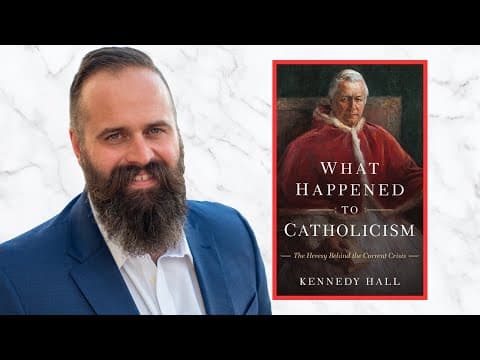
Kennedy Hall's new book, "What Happened to Catholicism?", delves into the heresy of modernism and its impact on the Catholic Church, tracing historical events from Pope Pius X's encyclical to the present day. Hall emphasizes the need for a deeper understanding of Catholic tradition to combat modernism's influence.
In a recent live stream, Kennedy Hall announced the release of his new book, "What Happened to Catholicism?" This book, which he describes as his magnum opus, explores the heresy of modernism and its profound effects on the Catholic Church. Hall expresses that this work is the culmination of his life's work thus far, and he aims to provide a comprehensive overview of the issues facing Catholicism today.
Hall reflects on the arduous yet rewarding process of writing this book. He emphasizes that it is the most significant work he has produced, filled with his heart and soul. The book is published by Sophia Press through the Crisis Imprint and is now available for purchase.
At the core of Hall's book is the heresy of modernism, which was notably condemned by Pope Pius X in his 1907 encyclical, Pashendi Dominichi Grais. This encyclical was directed to the bishops of the world and aimed to define modernism as a heresy that threatens the very foundation of the Church. Hall argues that modernism is not just a challenge to Catholicism but a threat to religion itself.
Hall provides a historical backdrop to the discussion of modernism, noting that the encyclical was published during a time of significant upheaval in Europe, including the First World War and the rise of totalitarian regimes. These events had a devastating impact on the Church, leading to a loss of traditional values and a shift towards liberalism.
The book also examines the changes that occurred during the Second Vatican Council, where modernism began to infiltrate the Church more subtly. Hall critiques the responses of various popes, particularly Pope Paul VI, who struggled to address the growing influence of modernist thought within the Church's hierarchy.
Hall stresses the importance of presenting a defense of Catholic tradition that is sophisticated and accessible. He acknowledges that while there is a tendency within the traditional Catholic community to oversimplify the issues, a more nuanced approach is necessary to engage a broader audience. His book, spanning 300 pages, is meticulously cited and aims to provide a thorough understanding of modernism's roots and its implications for the Church.
Throughout the writing process, Hall faced several challenges, including the need to remain charitable in his critique of modernism and the difficulty of engaging with complex philosophical ideas. He shares that reading modern philosophy was particularly painful, as it often contradicted the clarity found in traditional Catholic thought.
Despite these challenges, Hall found joy in revisiting the works of great philosophers like St. Thomas Aquinas. He recounts how engaging with scholastic thought was spiritually refreshing and intellectually invigorating, reinforcing the need to return to these foundational ideas in the face of modernism.
Kennedy Hall's "What Happened to Catholicism?" is not just a critique of modernism but a call to action for Catholics to engage deeply with their faith and traditions. By understanding the historical and philosophical underpinnings of modernism, Hall hopes to equip readers with the tools necessary to defend their beliefs against contemporary challenges. He invites readers to consider purchasing the book, not for profit, but as a means to foster a deeper understanding of Catholicism in today's world.



















