
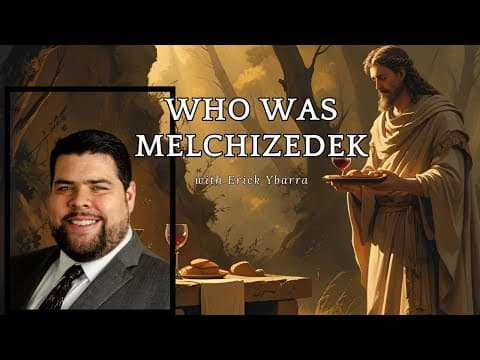
This blog post delves into the theological implications of Melchisedec's role in the Eucharist, as discussed by Eric Ybara. It explores his journey from atheism to Catholicism, the importance of historical context in understanding faith, and how Melchisedec's priesthood foreshadows the Eucharistic sacrifice of Christ. The discussion highlights the continuity of the priesthood and the necessity of transubstantiation, providing a comprehensive defense of the Eucharist rooted in scripture and early
In a recent conversation with Eric Ybara, a theologian and author, we explored the profound connections between Melchisedec, the Eucharist, and the priesthood of Christ. Ybara's insights stem from his own journey through various Christian denominations, ultimately leading him back to Catholicism. This blog post aims to unpack the theological implications of Melchisedec's role in the Eucharist and how it serves as a defense of Catholic doctrine.
Eric Ybara was born into a nominally Catholic family in Miami Beach, Florida. His early exposure to the faith was superficial, leading him to drift into atheism during his teenage years. However, a powerful conversion experience in college, sparked by a reformed Baptist evangelist, reignited his interest in Christianity. Ybara's journey took him through various Protestant denominations, including a strict Baptist church and later Lutheran and Anglican communities, before he ultimately returned to Catholicism.
Ybara emphasizes the significance of understanding the historical context of Christianity. His experiences in different denominations revealed a lack of historical continuity and authority, prompting him to investigate the origins of the church. This quest for historical roots led him to the early church fathers and the writings of the reformers, ultimately guiding him back to the Catholic Church, which he found to have a more substantial historical foundation.
Melchisedec, a mysterious figure from the Old Testament, plays a crucial role in understanding the Eucharist. He is mentioned in Genesis 14, where he offers bread and wine to Abraham, and in Psalm 110, which prophesies a priesthood in the order of Melchisedec. The author of Hebrews further elaborates on this connection, asserting that Christ's priesthood is eternal and superior to the Levitical priesthood.
Ybara argues that the typology of Melchisedec is essential for understanding the Eucharist. The bread and wine offered by Melchisedec foreshadow the Eucharistic sacrifice of Christ. In the Last Supper, Jesus takes bread and wine, declaring them to be his body and blood, thus fulfilling the Melchisedecian priesthood. This connection underscores the continuity of the priesthood and the necessity of transubstantiation in Catholic theology.
One of the central themes in Ybara's discussion is the idea that the Eucharist represents a perpetual sacrifice. Unlike the animal sacrifices of the Old Testament, which were temporary and covered sins, the sacrifice of Christ is eternal and efficacious. Ybara points out that the wounds of Christ remain as a testament to his ongoing sacrifice, reinforcing the notion that the Eucharist is not merely a memorial but a living participation in the sacrifice of Christ.
Transubstantiation is a key doctrine in Catholicism that asserts the bread and wine become the actual body and blood of Christ during the Mass. Ybara argues that this belief is rooted in scripture and the early church fathers, who consistently affirmed the real presence of Christ in the Eucharist. He challenges Protestant interpretations that reduce the Eucharist to a mere symbol, emphasizing that the biblical and historical evidence supports the Catholic understanding of the sacrament.
Eric Ybara's insights into the significance of Melchisedec in relation to the Eucharist provide a compelling defense of Catholic theology. His journey from atheism to Catholicism highlights the importance of historical context and the continuity of faith. By understanding Melchisedec's role as a precursor to Christ's priesthood, we can appreciate the depth and richness of the Eucharistic celebration in the Catholic tradition. Ybara's work encourages a deeper exploration of these theological concepts, inviting both Catholics and non-Catholics to engage with the profound mysteries of the faith.



















