
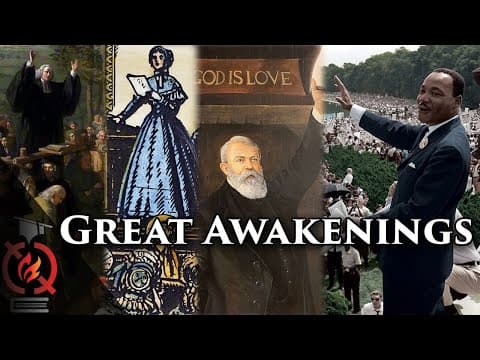
This blog post delves into the four Great Awakenings in American history, examining their causes, characteristics, and impacts on society and religion. It also discusses the possibility of a fifth Great Awakening in contemporary America, analyzing current trends in religiosity and cultural movements.
In American history, the Great Awakenings represent pivotal moments of religious revival and transformation. Dr. Hall Patton, a scholar in religion and American history, outlines the significance of these events, which have shaped the religious landscape of the United States. This post will explore the four Great Awakenings, their characteristics, and the potential for a fifth awakening in today's society.
By the early 18th century, the British colonies in North America faced a decline in religiosity. Disillusionment, political upheaval, and economic changes contributed to this decline. Established religions like Puritanism and Anglicanism struggled to maintain their influence as Enlightenment ideas gained traction.
In response, a movement emerged that emphasized personal commitment to God through emotional engagement and evangelism. This revivalist spirit was characterized by figures such as Jonathan Edwards and George Whitefield, who preached the necessity of conversion. The First Great Awakening led to the formation of new religious movements and a shift in congregational dynamics, with women becoming more active in church life and advocating for civil rights.
The Second Great Awakening arose in the early 19th century, following the American Revolution and amidst significant social changes. As Americans expanded westward, revival movements sought to restore Christianity to its primitive roots. This period saw the rise of various new religious movements, including Methodism and Mormonism, as well as the emergence of religious socialism.
The Second Great Awakening was also marked by social activism, with many denominations taking strong stances against slavery and advocating for women's rights. However, it eventually waned due to political tensions surrounding slavery and the sectional crisis leading to the Civil War.
Following the Civil War, the Third Great Awakening emerged as Americans sought solace in religion amidst the chaos of Reconstruction. This period saw the rise of spiritualism, theosophy, and the social gospel movement, which emphasized social justice and compassion as central tenets of Christianity.
The Third Great Awakening coincided with significant political movements, including temperance and women's suffrage. However, as scientific advancements challenged traditional beliefs, the revivalist fervor began to decline, leading to a fragmentation within religious communities.
The Fourth Great Awakening began in the 1960s, a time marked by social upheaval, civil rights movements, and the Cold War. Many Americans turned to religion for community and support after the traumas of World War II. This awakening was characterized by a surge in church membership and the rise of liberation theology, which sought to address social injustices.
However, the Fourth Great Awakening also witnessed a backlash against these progressive movements, as conservative evangelicalism gained prominence. The emergence of televangelism and the Moral Majority signified a shift towards a more fundamentalist approach to Christianity, culminating in a culture war that continues to influence American society today.
With the historical context of the Great Awakenings in mind, the question arises: are we currently experiencing a fifth Great Awakening? Dr. Patton suggests that while there are signs of religious fervor and new movements, the overall trend indicates a decline in organized religiosity. The rise of the "nones"—those who identify as agnostic, atheist, or unaffiliated—suggests a shift away from traditional religious practices.
However, the cyclical nature of these awakenings indicates that new movements could emerge, particularly in response to contemporary social and political changes. The potential for a fifth Great Awakening may depend on how society navigates current challenges and whether new forms of religious expression arise.
The Great Awakenings have played a crucial role in shaping American religious identity and societal values. By examining these historical events, we can gain insights into the patterns of religious revival and transformation. As we consider the possibility of a fifth Great Awakening, it is essential to reflect on the ongoing evolution of faith and its impact on American culture. The future remains uncertain, but the dialogue surrounding these awakenings continues to be relevant in understanding our collective spiritual journey.



















