
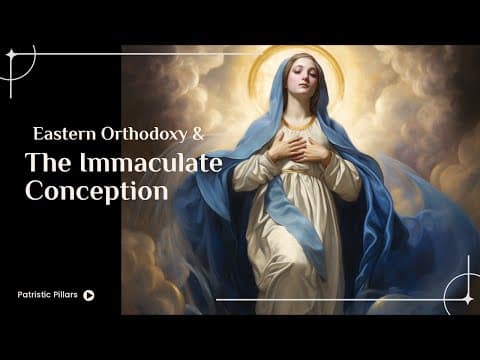
This blog post delves into the doctrine of the Immaculate Conception as defined by Pope Pius IX in 1854, tracing its biblical roots and historical acceptance in both Eastern and Western Christianity. It highlights the early Church Fathers' teachings on Mary’s sinlessness and contrasts them with contemporary Eastern Orthodox views, emphasizing the significance of this doctrine in Catholic theology and its implications for understanding Mary’s role in salvation history.
In 1854, Pope Pius IX defined the doctrine of the Immaculate Conception through the papal bull "Ineffabilis Deus." This doctrine asserts that the Virgin Mary was conceived without original sin, a belief that has deep biblical roots and historical significance in Christianity. This blog post will explore the origins of this doctrine, its acceptance in early Christianity, particularly among the Eastern Orthodox Church, and the contemporary views that have emerged.
The doctrine states that Mary, by a singular grace and privilege granted by God, was preserved free from all stain of original sin from the moment of her conception. The declaration reads:
"We declare, pronounce, and define that the doctrine which holds that the Most Blessed Virgin Mary... was preserved free from all stain of original sin is a doctrine revealed by God and therefore to be believed firmly and constantly by all the faithful."
While this doctrine was formally defined in 1854, it was believed by many in the Church long before this declaration. Biblical references, such as Genesis 3, suggest that Mary would be in complete enmity with the serpent, indicating her sinlessness.
The belief in Mary's sinlessness can be traced back to biblical texts. Genesis 3, often referred to as the Protoevangelium, speaks of the enmity between the woman and the serpent, which many theologians interpret as a foreshadowing of Mary's role in salvation history. This prophecy indicates that Mary would never fall under the dominion of sin, aligning with the Catholic understanding of her Immaculate Conception.
The teachings of early Church Fathers provide further support for the belief in Mary's sinlessness. Figures such as St. Ambrose of Milan and St. Ephraim the Syrian articulated views that align closely with the doctrine of the Immaculate Conception. St. Ambrose noted that Mary was free from every stain of sin, emphasizing her unique purity. Similarly, St. Ephraim referred to Mary as completely beautiful and without guilt, reinforcing the notion of her sinlessness.
Despite the early acceptance of the Immaculate Conception among some Eastern Orthodox theologians, the majority of Eastern Orthodoxy today does not uphold this teaching. This shift reflects a broader trend of divergence in beliefs between Eastern and Western Christianity over the centuries.
While some Eastern Orthodox theologians still affirm the Immaculate Conception, the prevailing view among Eastern Orthodox Christians is one of skepticism or outright rejection of the doctrine. This change is unfortunate, as it represents a departure from the ancient Apostolic Faith that once recognized Mary's unique role in salvation history.
The doctrine of the Immaculate Conception has profound implications for understanding Mary's role as the Mother of God. If Mary is the new Ark of the Covenant, as Catholic theology suggests, then her sinlessness is essential to her being the vessel that bore Christ. The parallels drawn between the Old Testament Ark and Mary highlight her unique sanctity and divine election.
Mary is often referred to as the new Ark of the Covenant, a title that underscores her purity and holiness. Just as the Old Ark was made of incorruptible wood and housed the Word of God, Mary, as the new Ark, is seen as being created without sin to carry the Word made flesh. This theological framework reinforces the belief that Mary was immaculately conceived, setting her apart from all other human beings.
The doctrine of the Immaculate Conception is deeply rooted in scripture and the teachings of early Church Fathers. While it has faced challenges and shifts in acceptance, particularly within Eastern Orthodoxy, its significance in Catholic theology remains profound. Understanding Mary's role as the Immaculate Mother not only enriches our appreciation of her but also deepens our understanding of the mystery of salvation. As we continue to explore this topic, it is essential to recognize the historical beliefs that shaped our understanding of Mary and the implications of these beliefs for contemporary faith practices.



















