
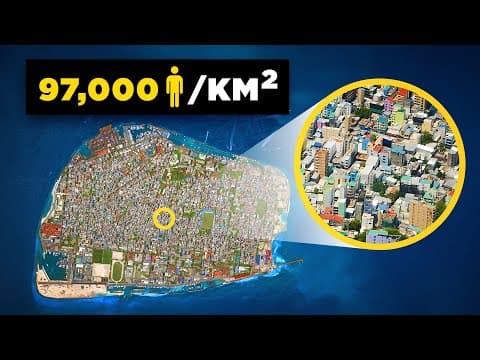
Mallay, the capital of the Maldives, is the most densely populated island on Earth, with a staggering population density of 97,436 people per square kilometer. This blog post delves into the history, current situation, and future challenges of Mallay, highlighting its rapid population growth, urbanization, and the looming threat of climate change.
Human population patterns can be fascinating, especially when examining extremes—both the sparsely populated areas and the densely packed urban centers. One of the most intriguing examples of extreme density is Mallay, a tiny island in the Indian Ocean, which is not only the capital of the Maldives but also potentially the most densely populated island in history.
The Maldives is an archipelagic state consisting of approximately 1,196 islands, most of which are quite small. The largest island measures only about 4 km in size, and the entire archipelago stretches over 871 km from north to south. Despite covering around 90,000 square kilometers, more than 99% of the Maldives is open ocean, with only 298 square kilometers of land. This makes the Maldives one of the smallest countries in the world in terms of land area.
As of 2024, the Maldives has a population of about 528,000, making it the fifth most densely populated country globally, trailing behind city-states like Monaco and Singapore. However, the situation is even more extreme when considering that nearly half of the Maldives' population resides on just two neighboring islands, which together cover only about 6 square kilometers.
The city of Mallay itself has a population of approximately 263,000, which is nearly half of the total population of the Maldives. The island of Mallay, measuring just 1.95 square kilometers, is home to around 190,000 people, translating to a staggering population density of about 97,436 people per square kilometer. This density is more than three times that of Manhattan, making Mallay one of the most densely populated places on Earth.
The Maldives has a rich history, with human settlement dating back around 2,500 years. The islands were first documented in 947 AD when Arab merchants began visiting. The introduction of Islam in 1153 led to the consolidation of the Maldives as a sultanate, with Mallay becoming the center of authority. However, it remained relatively small until the late 20th century.
The turning point for Mallay came in 1972 with the opening of the first tourist resort. This marked the beginning of a significant transformation in the Maldivian economy, shifting from a fishing-based economy to one heavily reliant on tourism. Under President Maumoon Abdul Gayoom's long rule from 1978 to 2008, the Maldives saw the development of numerous luxury resorts, which further centralized the population around Mallay.
As tourism flourished, so did the population of Mallay. The city became the epicenter of opportunity, attracting people from the outer islands seeking better jobs, education, and healthcare. This influx led to a rapid increase in population density, with the city filling in its central lagoon to accommodate newcomers.
Living conditions in Mallay are challenging due to the extreme density. Many families live together in cramped quarters, and the streets are often congested with vehicles. Despite the island's small size, 82% of the road space is occupied by vehicles, leaving only 18% for pedestrians. The reliance on imported diesel for electricity and desalination for water adds to the unsustainability of life on the island.
Mallay's situation is further complicated by climate change. The Maldives is one of the most vulnerable countries to rising sea levels, with 80% of its islands less than 1 meter above sea level. Projections indicate that much of the Maldives, including Mallay, could be submerged by the end of the century. The government has initiated geoengineering projects, such as the construction of Hulhumalé, a new island designed to alleviate overcrowding and serve as a climate refuge.
The future of Mallay and the Maldives is uncertain. With a rapidly growing population and the looming threat of climate change, the country faces significant challenges. By 2035, it is projected that up to 23% of the Maldivian population will reside in the capital, further exacerbating the density issue. The reliance on tourism, while economically beneficial, poses risks as the industry may not be sustainable in the long term due to environmental factors.
Mallay stands as a remarkable example of extreme urban density and the complexities that arise from rapid population growth and environmental challenges. As the Maldives navigates its future, the balance between development, sustainability, and climate resilience will be crucial in determining the fate of this densely populated island and its inhabitants.



















