
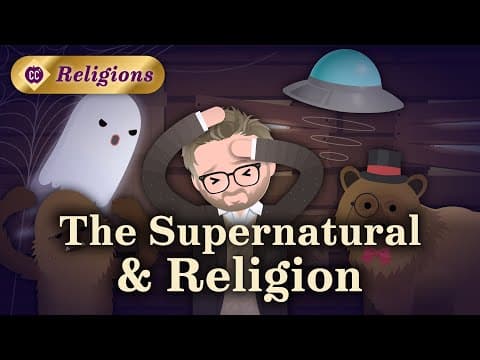
This blog post delves into the complex relationship between religion, spirituality, and paranormal beliefs, examining how individuals navigate their beliefs in a modern context where traditional religious affiliations are declining. It discusses the rise of the 'spiritual but not religious' movement, the cultural appropriation of spiritual practices, and the enduring belief in the paranormal across various demographics.
Hi, I’m John Green, and welcome to Crash Course Religions. Have you ever felt like something—or someone—is watching you? Perhaps it’s a tingle on the back of your neck, a scent in the air, or an unexplained noise from your attic. In a world where about four in ten Americans believe that the dead can communicate with us, the question arises: how does the paranormal fit into the broader context of religious beliefs?
The term "paranormal" encompasses a wide range of phenomena, from ghosts and telepathy to aliens and Bigfoot. It is often used interchangeably with "the supernatural," but typically refers to experiences that are unexplained by science and not widely accepted as religious beliefs. This distinction raises the question: paranormal to whom?
Take UFOs, for instance. Reports of unidentified flying objects have been documented for decades, even centuries, and recently gained significant attention from the U.S. Congress. While UFOs remain scientifically unproven and are not recognized by mainstream religious institutions, they fall under the category of the paranormal. In contrast, angels are generally considered supernatural phenomena, with about seventy percent of Americans believing in them. Interestingly, one-third of those who believe in angels do not identify with any religion, suggesting a complex relationship between belief and organized religion.
The phrase "spiritual but not religious" has gained traction, indicating a growing number of individuals who seek spiritual connections outside the confines of organized religion. Many of these individuals view organized religion as a barrier to authentic spiritual experiences. A Pew study found that those who identify as spiritual but not religious are more likely to believe that religion causes division and does more harm than good.
In 2023, seven out of ten adults in the U.S. described themselves as spiritual, with over twenty percent identifying as spiritual but not religious. This flexibility allows individuals to extract elements of religion that resonate with them while rejecting aspects they find problematic. For example, Shintō, a Japanese spiritual practice, attracts many non-Japanese practitioners due to its connection to nature and lack of rigid doctrines.
However, the selective adoption of spiritual practices can lead to cultural appropriation. Many Westerners engage with Daoist practices, such as meditation and tai chi, without embracing the full religious context, which can strip these practices of their original significance. Similarly, yoga, with its Hindu roots, has been secularized in the West, often used for self-improvement rather than spiritual connection.
Belief in ghosts transcends cultural boundaries, with over eighty percent of U.S. adults believing in souls or spirits. Ghost stories are prevalent in folklore and religious texts alike, illustrating how these beliefs help humans make sense of the world. For instance, the Hebrew Bible recounts the story of the prophet Samuel appearing to King Saul, while Hindu texts describe restless spirits known as bhuts.
The concept of lived religion highlights that individuals often blend various beliefs and practices, regardless of their formal religious affiliations. For example, a Sikh might encounter a UFO and incorporate that belief into their spiritual framework without abandoning their Sikh identity. Similarly, a Christian might practice yoga or use crystals for balance, demonstrating that spirituality can coexist with religious identity.
Ultimately, spirituality, the paranormal, and religion are interconnected, with individuals constructing their own eclectic versions of belief systems. Whether one identifies as spiritual but not religious, spiritual and religious, or religious but not spiritual, the essence lies in the belief itself. As we navigate this complex landscape, it becomes clear that the world is enriched when we believe in each other—and perhaps even in Bigfoot.
In our next episode, we will explore how religion and science may be more compatible than we often think. Thank you for joining me in this exploration of religion, spirituality, and the paranormal.



















