
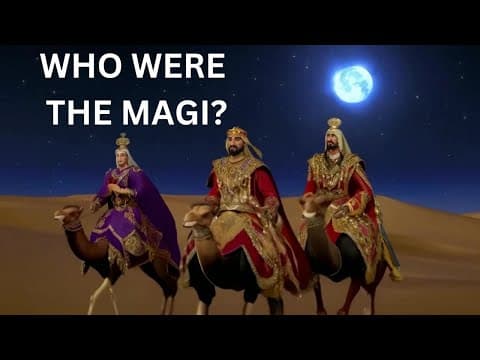
The Magi, often known as the Wise Men or Three Kings, are pivotal figures in the Nativity story, representing the universal call to worship Christ. Their journey from the East, guided by the Star of Bethlehem, symbolizes faith, determination, and the recognition of Jesus as King, God, and Savior. This blog post delves into their origins, the significance of their gifts, and the enduring lessons their story imparts about seeking divine truth and worship.
The Magi, often referred to as the Wise Men or Three Kings, are some of the most fascinating and mysterious figures in the story of Jesus' birth. They appear in the Gospel of Matthew (Matthew 2:1-12), traveling from the East to pay homage to the newborn King of the Jews. But who were these enigmatic visitors? Why did they leave their homeland to follow a star, and what can their journey teach us today? This post delves deep into the story of the Magi, exploring their possible origins, identities, and the celestial phenomenon that guided them.
The term "Magi" originates from the Greek word "magus," a designation given to learned men of the East in ancient Persia. The Magi were members of a priestly caste known for their expertise in astrology, dream interpretation, and the natural sciences. This positions them as scholars and intellectuals deeply immersed in the study of the stars and their symbolic meanings. In the ancient world, astrology was a respected discipline that sought to uncover divine messages through celestial phenomena.
The Magi's origins have sparked significant speculation, with Babylon, Persia, and Arabia being the most frequently proposed locations. Each of these regions offers historical and cultural clues:
Persia: Home to Zoroastrianism, one of the earliest monotheistic religions, the Magi likely had a strong understanding of astrology and celestial events. Their interpretation of the Star of Bethlehem would have been informed by their religious framework, emphasizing a cosmic struggle between good and evil.
Babylon: Known for its advanced astronomical studies, Babylon was a hub of intellectual activity. The Jewish presence in Babylon following the Babylonian exile may have influenced the Magi's understanding of Jewish prophecies, particularly those concerning the Messiah.
Arabia: The gifts of gold, frankincense, and myrrh were highly valued in the Arabian Peninsula, known for its lucrative trade routes. The Magi's offerings suggest a deep cultural and spiritual connection to this region.
The journey of the Magi is not just a tale of human effort; it is a testament to divine guidance and a powerful example of faith and action. They saw a sign in the heavens and left everything behind to seek the promised King. Their journey was fraught with challenges, including harsh climates, potential dangers from bandits, and the political intrigues of Herod's court. This unwavering determination reminds us that seeking God often requires sacrifice and perseverance.
The Magi's journey was guided by the Star of Bethlehem, a celestial phenomenon that has sparked endless speculation. Was it a miraculous sign created by God, or could it have been a natural event like a planetary conjunction or a comet? Scientific theories and theological insights have emerged over centuries, offering a deeper understanding of the star that led them to Jesus.
The gifts of the Magi—gold, frankincense, and myrrh—carry profound symbolic meaning that points to the identity and mission of Jesus:
By offering these treasures, the Magi acknowledged Jesus as King, God, and Savior, encapsulating the entire Gospel message in their act of worship.
The Magi's role in the Nativity narrative holds profound theological significance. Their inclusion reveals that the birth of Christ was not just for Israel but for all nations. These Gentile seekers recognized the kingship of Jesus and bowed in worship, symbolizing the universal nature of Christ's mission. It serves as a reminder that God's invitation to salvation extends to everyone, regardless of background or nationality.
Traveling such a great distance in ancient times was no small feat. The Magi braved harsh climates and potential dangers, driven by a deep conviction that the child they sought was no ordinary child but the Savior of the world. Their story invites us to reflect on our own willingness to follow God's call with determination, even when it means stepping into the unknown.
The story of the Magi is a call to action for every believer. It challenges us to seek God with all our hearts, to worship Him with our most valuable treasures, and to share the good news of His love with the world. The Magi's journey may have taken place over 2,000 years ago, but its message remains as relevant and inspiring as ever.
The Magi, shrouded in mystery and often romanticized in art and literature, were central figures in the Nativity story. Their journey, guided by the Star of Bethlehem, symbolizes the universal call to worship Christ. As we reflect on their story, we are reminded of the importance of faith, perseverance, and the willingness to follow divine guidance. The Magi's legacy continues to inspire believers to seek, worship, and honor the King of Kings, inviting us to consider the gifts we bring to Christ today. Are we willing to offer Him the treasures of our hearts, our time, talents, and resources as a sign of our devotion? Their story challenges us to seek Christ with humility and courage, following the light of faith wherever it leads.



















