
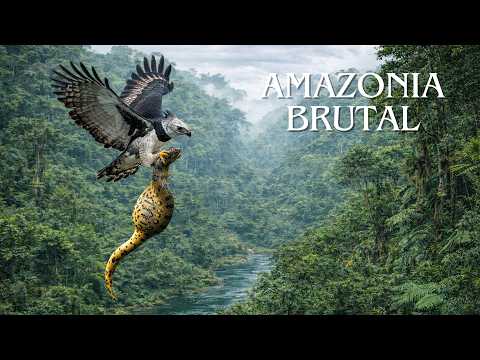
The Amazon rainforest, a vast and vibrant ecosystem spanning nine South American countries, is home to an incredible diversity of flora and fauna, including iconic predators like the jaguar, anaconda, and black caiman. This article explores the rich biodiversity, evolutionary history, ecological roles, and conservation efforts vital to preserving this sacred natural treasure.
The Amazon rainforest is a living testament to the infinite wisdom of nature, a vibrant and ancient secret etched into the heart of the Earth. This lush expanse pulses with life, embodying the very breath of our planet. Every drop of pure water and every trembling leaf carries a fragment of the world's soul.
Millions of years ago, the land that is now the Amazon was the floor of a primordial ocean. The mighty Amazon River once flowed from east to west, opposite to its current course toward the Atlantic Ocean. The rise of the Andes Mountains dramatically altered this flow, redirecting the river eastward and creating a vast, intricate network of waterways that nourish the region.
Covering nearly 6.7 million square kilometers across nine South American countries, the Amazon is the largest ecosystem on Earth. Brazil holds the lion's share, with about 60% of the forest. The Amazon River itself stretches over 7,000 kilometers, making it the largest river by volume worldwide.
The region enjoys a humid tropical climate with abundant rainfall averaging 2,500 mm annually and stable temperatures between 25 and 30 degrees Celsius. This climate sustains the forest's evergreen vitality and supports rare plants and animals revered by indigenous peoples as sacred gifts.
The Amazon is a symphony of biodiversity, home to approximately 390 billion trees spanning 16,000 species. These trees act as Earth's lungs, absorbing billions of tons of carbon dioxide annually and releasing essential oxygen.
The forest shelters about 10% of all known species on Earth, including over 3 million invertebrates, 2,200 fish species, 427 mammals, 13 bird species, 378 reptiles, and 400 amphibians. Each species plays a crucial role in maintaining the ecological balance.
The jaguar is the largest feline in the Americas and the third largest worldwide, after lions and tigers. With a robust, muscular body and a golden-yellow coat adorned with distinctive black rosettes, the jaguar is a master of camouflage in the dense forest.
Unlike many felines, jaguars have a diverse diet, preying on around 85 species ranging from fish and birds to deer, tapirs, and even caimans. They are exceptional swimmers, hunting aquatic prey with ease.
Their bite is the most powerful among big cats, capable of exerting up to 69,000 kcals of force, allowing them to pierce the skulls of their prey, instantly neutralizing them.
One of the largest and heaviest snakes globally, the green anaconda can reach lengths of up to 9 meters and weigh over 200 kilograms. This constrictor moves silently through flooded forests and shallow waters, ambushing prey such as capybaras with crushing force.
Though non-venomous, its muscular strength is lethal, enabling it to swallow prey nearly its size.
The black caiman is the largest member of the alligator family in South America, growing up to 6 meters and weighing over 400 kilograms. Its dark skin camouflages it in the blackwater rivers, making it an apex aquatic predator.
With a bite force comparable to the saltwater crocodile, it preys on capybaras, deer, and fish, playing a vital role in controlling prey populations and maintaining ecosystem health.
Agile and intelligent, spider monkeys use their prehensile tails as a fifth limb to navigate the forest canopy. They live in social groups, communicate through vocalizations and gestures, and play a key role in seed dispersal, aiding forest regeneration.
These vibrant birds are social and intelligent, often flying in pairs or flocks. Their strong beaks allow them to crack hard nuts, and they contribute to forest health by dispersing seeds over large distances.
Known for their slow movements, these sloths spend most of their lives in the canopy, feeding on leaves and hosting symbiotic algae in their fur for camouflage. Their slow metabolism and unique digestion allow survival on a low-nutrient diet.
The smallest primate in the world, pygmy marmosets are highly social and agile, living in family groups. They feed on tree sap, insects, and fruits, and their sharp claws help them cling to tree bark.
With a large, colorful bill, the toucan accesses fruits unreachable by other birds. Its bill also serves as a defense mechanism and a cooling system. Toucans live in small groups and are vital seed dispersers.
These small, brightly colored frogs possess potent toxins that deter predators. Indigenous peoples have historically used their toxins for hunting. They exhibit fascinating parental care behaviors.
Famous for their sharp teeth and powerful bite, piranhas are both predators and scavengers, playing an important role in river ecosystems by cleaning up carrion.
One of the largest freshwater fish, the arapaima can grow up to 3 meters and breathe air using a modified swim bladder. It is a top predator and an important food source for indigenous communities.
Adapted to life in dark caves, these fish have lost their eyesight but developed enhanced sensory systems to navigate and find food in complete darkness.
Specialized in feeding on mammalian blood, vampire bats use sharp teeth and anticoagulant saliva to feed painlessly. They live in social groups and exhibit altruistic behaviors.
A large snake that uses heat-sensing organs to hunt in the dark caves of the Amazon, the boa constrictor is an effective predator of medium to large prey.
Seasonal flooding transforms vast areas of the Amazon into aquatic landscapes known as varzea (whitewater flooded forests) and igapó (blackwater flooded forests). These ecosystems teem with life adapted to the changing waters.
The largest rodent in the world, capybaras are excellent swimmers and live in social groups. They graze on aquatic plants and grasses, playing a key role in nutrient cycling.
Despite its grandeur, the Amazon faces severe threats from deforestation, climate change, and human exploitation. Since the 1970s, over 17% of the forest has been lost, an area larger than France.
The Amazon is a sacred gift that demands stewardship rather than destruction. Conservation initiatives like the Amazon Region Protected Areas Program (ARPA) have made significant strides in protecting over 60 million hectares of forest.
Indigenous communities, such as the Kayapó, actively manage and protect millions of hectares, demonstrating the power of traditional knowledge combined with modern conservation.
The preservation of the Amazon is a global responsibility. Supporting conservation organizations, raising awareness, and adopting sustainable lifestyles are vital steps everyone can take.
The Amazon is not only the Earth's lungs but also a living testament to the divine creativity and interconnectedness of life. Protecting it ensures the survival of countless species and the health of our planet for generations to come.
The Amazon rainforest remains a realm of mystery and wonder, where every creature, from the smallest frog to the mighty jaguar, plays a part in a magnificent ecological symphony. Its preservation is essential for the balance of life on Earth and a profound reminder of our duty to honor and protect the natural world.



















