
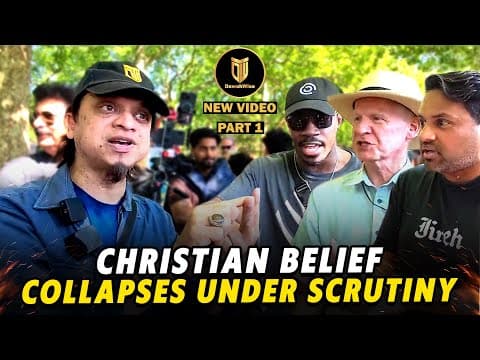
This blog post delves into a complex dialogue about the nature of God, the concept of miracles, and the inherent powers attributed to Jesus Christ within Christianity. It examines the distinctions between natural and supernatural laws, the essence of divinity, and the implications of dependency and independence in the context of the Trinity.
In a recent discussion at Speakers Corner, a thought-provoking dialogue unfolded regarding the nature of God, the concept of miracles, and the inherent powers attributed to Jesus Christ. This conversation not only challenged traditional views but also sought to clarify the distinctions between natural and supernatural laws, as well as the essence of divinity within Christianity.
The dialogue began with a fundamental question: If God were dependent on another being for His existence, could that being truly be called God? This question set the stage for a deeper exploration of the nature of God, particularly in the context of the Christian Trinity.
One participant argued that if God is self-sufficient, He must exist independently of any other being. This raises the question: Can a being that is dependent on others for existence be considered divine? The discussion highlighted the belief that God, as described in Christianity, is independent and self-sufficient, existing as one essence in three persons: the Father, the Son, and the Holy Spirit.
The conversation then shifted to the topic of miracles, with participants debating whether miracles are a suspension of natural law or simply a manifestation of divine authority operating within natural laws.
A miracle was defined as an extraordinary event that defies ordinary experience. However, the participants argued that what is often labeled as a miracle is merely a different application of natural laws that are not typically observable. For instance, the burning of fire is a natural law, yet the fire did not consume the prophet Abraham, which some might consider a miracle. This led to the assertion that miracles are still governed by the laws of God, albeit in ways that may not be immediately apparent to human understanding.
The discussion further explored the miracles attributed to Jesus, such as healing the sick and raising the dead. One participant questioned whether Jesus performed these miracles by His own inherent power or if He acted under divine authority. The response highlighted that Jesus often stated He could do nothing of His own accord but only what He saw the Father doing, suggesting a relationship of dependency on the Father.
A significant point of contention arose regarding the nature of Jesus within the Trinity. If Jesus is considered fully divine and self-sufficient, does that mean He possesses inherent power independent of the Father? The dialogue examined whether Jesus, as the second person of the Trinity, could exist without the Father and the Holy Spirit.
The concept of the hypostatic union was introduced, which posits that Jesus is both fully God and fully man. This duality raises questions about His knowledge and power. For example, when Jesus stated that He did not know the hour of His return, it was argued that this admission contradicts the notion of being all-knowing, a characteristic attributed to God.
The dialogue at Speakers Corner illuminated the complexities surrounding the nature of God, the concept of miracles, and the inherent powers of Jesus Christ. It challenged participants to consider the implications of dependency and independence within the Trinity and to reflect on the definitions of miracles in light of natural laws. Ultimately, this conversation serves as a reminder of the rich theological discussions that continue to shape our understanding of divinity and the extraordinary events that occur within our world.



















