
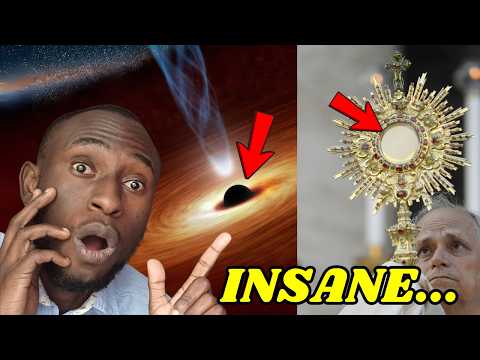
This blog post delves into the intriguing parallels between black holes and the Catholic Eucharist, illustrating how both embody profound mysteries that challenge our understanding of reality. It emphasizes the importance of faith in perceiving the true nature of the Eucharist, akin to the unseen forces of black holes, and encourages a deeper appreciation of both concepts.
Imagine standing at the edge of something so powerful that light itself cannot escape. Space and time bend, and physics collapses into mystery. You are staring at a black hole, a cosmic abyss where the known world stops and the unknown begins. Astronomers spend lifetimes trying to understand black holes, yet the closer they look, the more they resist being fully explained.
Now, imagine kneeling before the Eucharist. It appears as simple bread and wine, devoid of visible energy or light. Yet, the Church proclaims, "This is my body. This is my blood" (Luke 22:19-20). This presents a paradox: the reality is infinitely greater than what our senses can detect. The more I study both physics and theology, the more I realize that every black hole serves as a parable of the Eucharist.
Black holes pull matter toward their center, while the Eucharist draws all creation toward Christ. Both phenomena hide their true nature beyond an event horizon. The event horizon of a black hole marks a boundary where escape becomes impossible, while the Eucharist conceals divine glory beneath the appearance of bread and wine. Contemplating a black hole could deepen your love for the Blessed Sacrament, and ignoring this parallel might cost you a greater intimacy with God.
In our modern age, many Catholics approach the Eucharist as merely symbolic—a spiritual gesture or sacred tradition—but not as the living Christ. A 2019 Pew Research study revealed that nearly 70% of self-identified Catholics in the United States believe the bread and wine are only symbols. This misunderstanding represents a significant collapse of faith in one of the Church's most central truths.
It's akin to looking at a black hole in a photograph and saying, "Oh, that's just a shadow in space." Technically, yes, that's what the human eye sees, but in reality, that shadow marks the presence of something unimaginably massive, shaping galaxies, bending light, and altering time itself. Just because you cannot see the reality directly does not mean it is not there.
Many Catholics do not doubt Jesus's power; they simply do not connect that power to the small host placed in their hands. This disconnect is a spiritual crisis. If the Eucharist truly is, as the Catechism teaches in paragraph 1374, the body and blood together with the soul and divinity of our Lord Jesus Christ, then treating it as merely symbolic misses the gravitational center of the entire Catholic faith.
The problem lies partly in our senses, which can deceive us. Sight, taste, and touch tell us one story, while faith tells us another. Science faces a similar challenge when studying black holes. No one has ever seen one directly; everything we know comes from indirect evidence—such as the bending of starlight, the movement of nearby stars, and the radiation from matter spiraling inward. In both cases, black holes and the Eucharist, reality exists, but it requires more than casual observation to grasp.
The Eucharist is not an invention of the medieval Church; it is rooted in the very words of Jesus. At the Last Supper, he took bread, blessed it, broke it, and gave it to his disciples, saying, "This is my body" (Matthew 26:26). In John 6, he intensifies this point: "Unless you eat the flesh of the Son of Man and drink his blood, you have no life in you" (John 6:53). The reaction was so strong that many of his disciples turned back (John 6:66).
The early Church took these words literally. St. Ignatius of Antioch, writing in AD 110, warned against those who abstain from the Eucharist because they do not confess that it is the flesh of our Savior Jesus Christ (Letter to the Smyrnaeans 6:2). St. Cyril of Jerusalem in the 4th century instructed his catechumens not to regard the bread and wine as simply that; they are the body and blood of Christ (Catechetical Lecture 22). The Catechism echoes this unbroken tradition, stating that by the consecration, the transubstantiation of the bread and wine into the body and blood of Christ is brought about (CCC 1376).
The term transubstantiation is key here. The substance changes while the appearances remain. This is where the black hole analogy becomes fascinating. In physics, the event horizon marks the point of no return. You could look at it from a distance and see only darkness, yet cross that invisible boundary and encounter an entirely different reality. In the Eucharist, the event horizon is the appearance of bread and wine. Your senses detect one thing, but beyond that boundary lies the fullness of Christ himself.
Even Pope Benedict XVI noted that the Eucharist is a mystery of presence—Christ is truly present but under sacramental signs that veil his glory. Both black holes and the Eucharist involve encountering a reality that is hidden yet immensely powerful.
Gravitational Pull: A black hole's gravity is so strong that nothing, not even light, can escape. Similarly, the love of Christ in the Eucharist has a gravitational pull on the soul. "When I am lifted up from the earth, I will draw all people to myself" (John 12:32). The Eucharist is that lifting, drawing the Church into Christ's very heart.
Event Horizon: The boundary around a black hole is where the escape velocity equals the speed of light. From the outside, it appears as a dark circle, but from within, it reveals another universe of physics. In the Eucharist, the event horizon is the veil of bread and wine. Cross it in faith, and you enter the presence of the infinite God.
Singularity: At the center of a black hole lies a point of infinite density, where all mass is compressed into a single point. In the Eucharist, the singularity is Jesus himself—whole and entire, body, blood, soul, and divinity in every fragment of the host and every drop of the precious blood, the infinite compressed into the finite.
Transformation of What Enters: Matter that falls into a black hole is forever changed. In the Eucharist, the transformation is even more profound. We consume the body of Christ, but as St. Augustine said, we do not change him into ourselves; we are changed into him.
Invisible Influence: Black holes shape galaxies without being directly seen. The Eucharist shapes the Church and the world in hidden ways, strengthening saints, sustaining priests, and converting sinners. You cannot measure it with an instrument, but you can see its effects in transformed lives.
In Eucharistic adoration, you are like an astronomer staring at the event horizon. You may not see the singularity, but you feel its pull, sense its mystery, and align your life to its center.
Some might argue that black holes are destructive and question how they can be likened to Christ in the Eucharist. While black holes consume matter, Christ consumes sin and death. The pull of the Eucharist is not to annihilate your existence but to perfect it.
Others may object that science is about measurable proof while faith is about belief, questioning the mixing of the two. However, both science and faith seek truth. Science teaches us how creation works, while faith reveals who made it and why. Using the language of creation to describe the Creator's mysteries is deeply biblical, as Psalm 19 declares, "The heavens declare the glory of God."
Some may view this as merely a poetic metaphor. Yet, Jesus himself used parables drawn from nature—seeds, vineyards, fishing nets. If he walked the earth today, he might point to images from the event horizon telescope and say, "The kingdom of God is like a black hole which a Creator placed in the heart of a galaxy."
Here are the key takeaways:
The next time you see an image of a black hole, remember that at the center of your parish church is something infinitely greater: the living Jesus in the Blessed Sacrament, waiting to draw you into his eternal love. If this message inspired you, consider sharing it with a friend and continue walking this journey of faith with us. Let us live as people who have encountered the singularity of divine love and have been forever changed.



















