
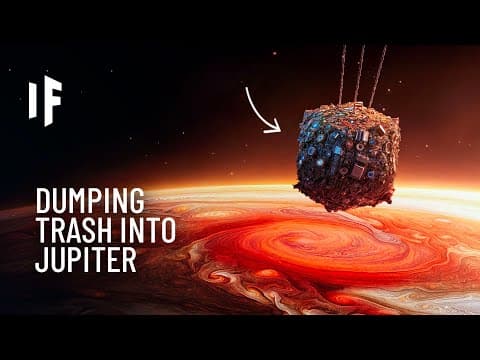
This blog post examines the hypothetical scenario of sending Earth's waste to Jupiter, discussing the complexities of waste management, the technological advancements required, and the potential consequences of such an endeavor.
Jupiter, the largest planet in our Solar System, is a gas giant capable of condensing millions of tons of space debris. This raises an intriguing question: could we solve one of Earth's most pressing problems—our trash—by sending it to Jupiter? In this exploration, we will delve into the logistics, technological requirements, and implications of such a radical idea.
Before we consider launching rockets filled with garbage into the depths of space, it is essential to understand how waste is currently managed on Earth. Waste management is a complex process that varies significantly around the world. Common strategies include curbside bin pickups and advanced recycling sorting programs. After disposal, trash typically ends up in landfills or incinerators, depending on regional infrastructure.
However, not all waste makes it to these designated areas. Human litter can be found almost everywhere, including remote locations like the Pacific Ocean, which is home to the infamous Great Pacific Garbage Patch. As landfills overflow and environmental concerns grow, humanity is increasingly desperate for innovative solutions to waste management.
Imagine a program designed to transport garbage from our driveways to the atmosphere of Jupiter. This would require significant technological advancements and unprecedented international cooperation. The first step would involve reimagining our waste collection systems.
Initially, individuals might still dispose of their waste in familiar bins. However, local, regional, and national governments would need to implement sophisticated automated drone systems to process this waste for space travel. The trash would need to be compacted to maximize the payload of each rocket, necessitating compactor sites capable of handling vast amounts of garbage. With approximately 2.1 billion metric tons of global waste produced annually, the scale of this operation would be unprecedented.
Moreover, it would be crucial to decontaminate the waste to eliminate any terrestrial microbes that could potentially harm extraterrestrial ecosystems. The last thing we would want is to introduce Earth-based diseases to other planets, which could have catastrophic consequences for any existing life forms.
Transporting this colossal mass of trash across the Solar System would require spacecraft of unprecedented size and capability. These vessels would need to withstand long journeys while carrying immense weight. Advanced propulsion systems, such as nuclear fusion or ion thrusters, would be essential for launching these trash-laden rockets into orbit.
Upon reaching Jupiter, the spacecraft would release their cargo into the planet's atmosphere. The powerful gravitational force of Jupiter would ensure that the trash descends into the swirling gases below. Initially, the waste would encounter freezing temperatures of about -145 °C (-234 °F) and pressures equivalent to sea level on Earth.
As the trash descends further, the atmospheric pressure would increase dramatically, causing the cargo bins to erode and collapse. Eventually, the waste would disintegrate into its elemental components in the extreme heat of Jupiter's core, where temperatures can reach up to 24,000 °C (43,000 °F). This process could be seen as a form of recycling, as our trash would be broken down into its most basic elements.
While the idea of sending our trash to Jupiter may seem appealing, it raises several critical questions. If we had a reliable method for disposing of waste in space, would we become complacent about our consumption habits? Would we produce even more trash, knowing we could simply send it away?
Additionally, the environmental impact of developing such massive spacecraft and the fuel required for launch must be considered. The resources and waste generated by this endeavor could outweigh the benefits of sending trash to Jupiter.
Before embarking on a project as ambitious as dumping our trash into Jupiter, we must first address how we treat our own planet. Collaborating with governments and corporations to reduce consumption, enhance recycling systems, and design a sustainable future is crucial. Perhaps, instead of looking to the stars for waste disposal, we should consider more immediate solutions, such as utilizing volcanic activity closer to home.
This thought experiment serves as a reminder of the importance of responsible waste management and the need for innovative solutions to protect our planet.



















