
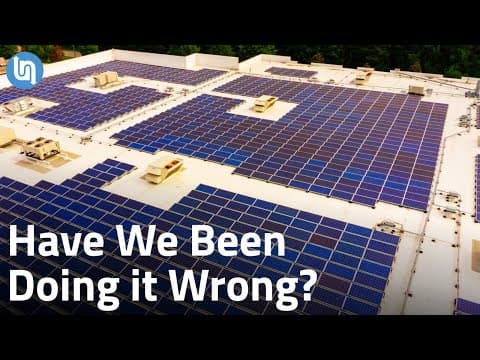
This blog post delves into the feasibility and potential of utilizing rooftop solar energy as a solution to renewable energy challenges, discussing the benefits, limitations, and innovative approaches to solar energy deployment.
Growing the world’s renewable energy capacity has always been a delicate balancing act, particularly when it comes to land use. As utility-scale solar and wind parks expand globally, the conversation around clean energy becomes increasingly complex. This complexity arises not only from local opposition but also from significant environmental and social concerns. The pressing questions are: How much solar power can we generate from rooftops? Can rooftop solar provide sufficient energy while minimizing legal and ecological issues? Ultimately, do we have enough space for solar?
Utility-scale solar is certainly a step up from fossil fuels like coal, but the considerations extend beyond aesthetics. Large solar farms can consume vast amounts of water during construction, threatening local water supplies, especially in sunny regions with limited resources. Additionally, these projects can disrupt local ecosystems through construction noise, dust, glare, and wildlife displacement. For instance, the Aratina Solar Center's construction involved the destruction of state-protected Joshua trees in California, raising valid concerns about the environmental impact of such large-scale projects.
Even when solar farm proposals navigate bureaucratic hurdles, the timeline for bringing them online can be lengthy. In the U.S., the grid connection backlog is significant, with over 95% of projects in interconnection queues being renewable, primarily solar. By the end of 2023, nearly 2.6 Terawatts of solar projects were awaiting assessment, which is more than double the current U.S. generation capacity. Unfortunately, many of these projects do not reach completion, highlighting the challenges faced in expanding solar energy.
In contrast, rooftop solar can bypass many of these obstacles. While homeowners still face permitting challenges, they do not have to contend with lengthy impact studies. Rooftop solar utilizes existing space, allowing homeowners to generate power on-site without relying on transmission lines.
The question arises: how much energy could we generate from rooftops alone? This inquiry is complex and cannot be distilled into a single statistic due to numerous variables. Researchers have been exploring this question for years, employing various measures of potential.
The U.S. National Renewable Energy Laboratory (NREL) categorizes solar potential into different types, starting with physical constraints—how much solar radiation hits a rooftop. The technical potential refers to what a solar system can achieve in a specific environment, disregarding market or policy constraints. However, this technical potential does not reflect real-world limitations such as costs, regulations, and public acceptance.
To illustrate the complexities of estimating rooftop solar potential, consider a 2016 study from Yonsei University focusing on Seoul's Gangnam district. The study analyzed three types of potential:
The findings revealed that only 12.17% of the physical potential could be converted into electricity. Notably, this technical potential could cover a quarter of Gangnam's energy needs, demonstrating the significant impact rooftop solar could have, even in a single district.
Estimating solar potential is a layered and intricate process. Researchers must consider various assumptions, which can lead to vastly different estimates. A review of rooftop solar potential studies shows pronounced differences in estimates, emphasizing the difficulty of accurately predicting solar energy generation.
Moreover, theoretical plans cannot account for every community or individual decision that may affect solar deployment. For instance, a prime solar site may lack the necessary policy incentives to facilitate development. NREL's findings on community solar highlight that the actual benefits accrued are often a fraction of high-end estimates based on technical potential.
The debate between utility-scale solar farms and widespread rooftop solar may overlook the potential for dual-use solutions. Solar efficiency is highly location-dependent, suggesting that a combination of both approaches may be the most effective strategy.
Innovative practices like agrivoltaics allow for the coexistence of agriculture and solar energy generation. Solar panels can protect crops, reduce water usage, and provide shade for livestock, creating a symbiotic relationship between food production and energy generation. Additionally, practices such as solar grazing, where livestock maintain solar panel fields, can reduce maintenance costs.
Another promising avenue is floatovoltaics—solar panels installed on bodies of water. This approach can be applied to irrigation canals, lakes, and even oceans, maximizing space and efficiency. Recent projects in India, California, and the Philippines demonstrate the growing interest in this technology.
As we explore the potential of rooftop solar, it becomes clear that the main conflict is not about space but rather about prioritizing and assessing impacts on a case-by-case basis. The rapid deployment of solar technology, decreasing costs, and increasing efficiency indicate that we have numerous options available.
In conclusion, there is indeed space for solar energy that does not require extensive land clearing. Dual-use implementations appear to be the key to maximizing solar potential. What innovative solar solutions excite you? Join the conversation in the comments and share your thoughts on the future of solar energy.



















