
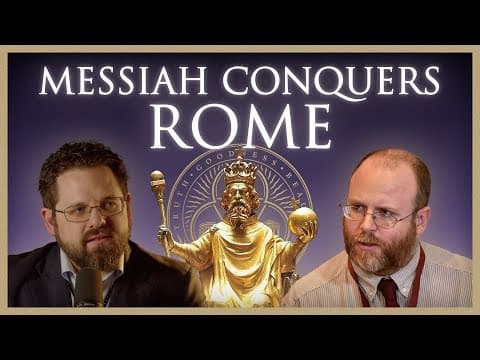
In this blog post, we delve into the profound insights shared by Dr. Alan Fimister in his interview about the Romaness of the Church. We explore the historical, theological, and eschatological implications of the Church's relationship with Rome, the significance of prophecy, and the enduring legacy of the papacy. This discussion highlights the intricate connections between the Old Testament, the New Testament, and the unfolding of Church history, culminating in the understanding of Christ's rule
Welcome to Eternal Christendom, where we delve into the rich tapestry of Christian history and theology. In this post, we explore the insights shared by Dr. Alan Fimister in his interview regarding the Romaness of the Church, a topic that has captivated many and continues to resonate in contemporary discussions.
In a previous episode titled "Christ's Church is Roman," Dr. Fimister discussed his book, The Iron Scepter of the Son of Man, which argues that the Roman Empire is prophesied in the Old Testament to be transformed and fulfilled in the New Testament through the Church. This post serves as a continuation of that discussion, highlighting key themes and insights from the interview.
Dr. Alan Fimister hails from Newcastle upon Tyne, England. He studied modern history at Herford College, Oxford University, and later pursued Catholic theology, teaching at various institutions across Europe and the United States. His scholarly work includes publications on European political history and Thomistic political philosophy, making him a prominent voice in contemporary theological discourse.
Dr. Fimister begins by discussing the prophetic significance of the Roman Empire as depicted in the Book of Daniel. He explains that Daniel outlines a four-fold schema of empires that would rule over God's people, culminating in the Roman Empire, symbolized by iron. This prophecy sets the stage for understanding how the Church, as the mystical body of Christ, fulfills the expectations of the Messiah.
The transition from the fourth monarchy (the Roman Empire) to the fifth monarchy (the reign of Christ) is a central theme in Dr. Fimister's work. He emphasizes that this transition is not instantaneous but unfolds over time, beginning with Christ's life, death, and resurrection, and continuing until the end of the world. The Church, therefore, is seen as the continuation of Christ's reign on earth.
Dr. Fimister highlights the Church's role in salvation history, particularly in relation to the prophecies of the Old Testament. He discusses how the Church embodies the fulfillment of God's promises to Israel, transforming the understanding of the covenant and extending it to all nations. This universal aspect of the Church is crucial in understanding its Romaness.
A pivotal moment in the history of the Church is the Edict of Thessalonica issued by Emperor Theodosius, which declared the faith delivered by the Apostle Peter as the official religion of the Roman Empire. This edict not only solidified the Church's authority but also marked a significant shift in the relationship between the Church and the state.
Dr. Fimister discusses how the title "Pontifex Maximus" was conferred upon the Pope, signifying the spiritual authority of the papacy over the temporal power of the emperor. This distinction is vital in understanding the Church's role as the moral compass of society, guiding the faithful in matters of faith and morals.
The discussion also touches on eschatological themes, particularly the role of the Church in the end times. Dr. Fimister explains that the Church will undergo a passion similar to that of Christ, facing persecution and trials before the second coming of Christ. This perspective invites the faithful to remain vigilant and steadfast in their faith.
The concept of the "katakon" or restraining power is explored, suggesting that the Church serves as a barrier against the full manifestation of the Antichrist. This idea underscores the importance of the Church's mission in the world and its role in preserving the moral order.
In conclusion, Dr. Alan Fimister's insights into the Romaness of the Church provide a profound understanding of the Church's historical, theological, and eschatological significance. As we reflect on these themes, we are reminded of the enduring legacy of the Church and its pivotal role in God's plan for salvation. The discussion sets the stage for further exploration of the eschatological implications of the Church's Roman identity in future conversations.
Stay tuned for part three, where we will delve deeper into the eschatological aspects of the Romaness of the Church and its implications for the future of Christendom.



















