
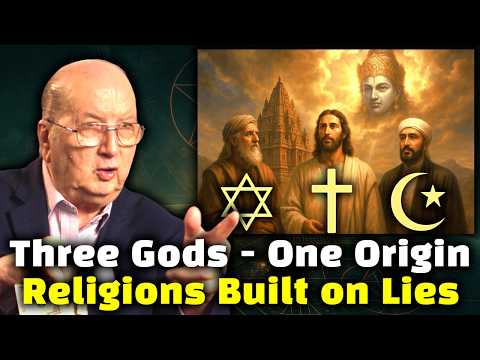
This blog post delves into the historical connections between Judaism, Christianity, and Islam, tracing their origins back to Hinduism and ancient pagan beliefs. It discusses the symbolism shared among these religions, the significance of key figures, and the influence of ancient cultures on modern religious practices.
In a thought-provoking discussion, Jordan Maxwell explores the historical connections between Judaism, Christianity, and Islam, suggesting that all three religions can be traced back to ancient Hinduism and pagan beliefs. This blog post aims to unpack these claims, examining the symbols, figures, and cultural influences that have shaped these major world religions.
Maxwell asserts that all major religions are fundamentally based on a triangular pyramid structure. This triune concept is evident in the representations of deities across different cultures:
Maxwell emphasizes that the origins of Judaism, Christianity, and Islam can be traced back to Hinduism in India. He points out that many symbols found in these religions, such as the six-pointed star (often associated with Judaism), have their roots in Hindu and Buddhist traditions. The star, known as the Star of David, was not recognized as such until the late 19th century, indicating a relatively recent appropriation of ancient symbols.
The discussion highlights how the United States, as a republic, can also trace its roots back to Indian civilization. Maxwell argues that the foundational elements of Judaism and Christianity are steeped in ancient pagan practices, suggesting that the narratives surrounding key figures like Abraham and Moses may be more symbolic than historical.
Maxwell raises provocative questions about the existence of pivotal figures in these religions:
Maxwell delves into the symbolism associated with various religious practices, particularly in Islam. He notes that the color green, prevalent in Islamic flags, is associated with Venus, and the crescent moon symbolizes the same celestial body. This connection to ancient astronomical worship reflects a broader theme of celestial reverence across religions.
Maxwell argues that the Vatican represents a continuation of Roman power, suggesting that the Roman Empire has not disappeared but transformed into a religious institution that continues to exert influence over Europe and beyond. He posits that the Vatican is one of the most effective secretive organizations in history, controlling narratives and maintaining power through a complex web of symbolism and tradition.
A significant theme in Maxwell's discussion is the manipulation of truth by those in power. He questions the importance of truth in society, suggesting that people often prefer comforting narratives over harsh realities. This manipulation extends to religious teachings, where the truth is often obscured to maintain control over followers.
Maxwell's exploration of the connections between Judaism, Christianity, and Islam reveals a complex tapestry of historical and cultural influences. By tracing these religions back to their Hindu roots and examining the shared symbols and narratives, we gain a deeper understanding of the spiritual landscape that shapes our world today. The discussion challenges us to reconsider the origins of our beliefs and the stories we tell about them, urging a more profound inquiry into the nature of faith and its historical context.



















