
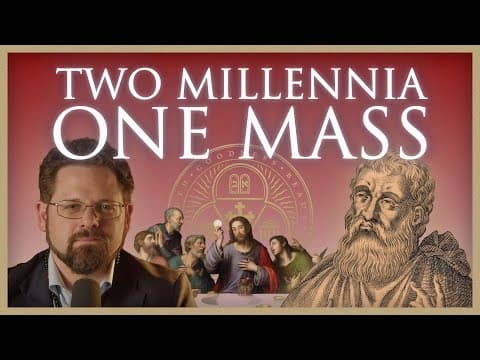
This blog post delves into the teachings of St. Justin Martyr from the second century, highlighting the early Christian worship practices, the significance of the Eucharist, and the continuity of these traditions in the Catholic Church today. It outlines the essential elements of the Mass, the role of clergy, and the conditions for receiving the Eucharist, demonstrating how these practices were established in the early Church and remain relevant today.
What if I told you that the outline of the Catholic Mass, the belief about the Eucharist, and the guidelines for receiving it worthily were all established in the second century? In this post, we will explore the teachings of St. Justin Martyr, one of the early Church's foremost apologists, who provided a detailed account of early Christian worship and the Eucharist.
St. Justin Martyr was a significant figure in the early Church, known for his defense of Christianity against paganism and Judaism. He was martyred during the reign of Emperor Marcus Aurelius in the 160s AD for refusing to sacrifice to Roman gods. His writings, particularly his First Apology and Dialogue with Trifo, offer profound insights into the practices and beliefs of early Christians.
Our central thesis is that St. Justin Martyr's writings testify to the essential elements of the sacrifice of the Mass that continue to be present and taught by the Catholic Church today. We will examine his descriptions of Christian worship, focusing on the Eucharist, the role of priests, and the conditions for receiving the sacrament.
St. Justin describes the Eucharist as a sacrifice of bread and wine, instituted by Christ as a memorial of His passion. He asserts that this sacrifice becomes the true body and blood of Jesus Christ after the prayer of consecration. In his First Apology, he states:
"And this food is called among us Eucharistia, the Eucharist, of which no one is allowed to partake, but the man who believes that the things which we teach are true, and who has been washed with the washing that is for the remission of sins and unto regeneration."
This highlights the belief that the Eucharist is not merely symbolic but a true transformation into Christ's body and blood.
St. Justin outlines specific conditions for receiving the Eucharist:
These conditions reflect the Catholic Church's current teachings on the Eucharist, emphasizing the importance of faith, baptism, and moral integrity.
St. Justin emphasizes that the Eucharist is offered only by priests, who are responsible for the distribution of communion. He refers to the leader of the worship as the "president" and notes that deacons assist in the distribution. He writes:
"There is then brought up to the president of the brethren bread and a cup of wine mixed with water. We do all of that to this very day."
This indicates a structured liturgy that mirrors the Catholic Mass today, where ordained ministers lead the worship and distribute the Eucharist.
St. Justin also notes that Christian worship takes place on Sunday, the day of Jesus's resurrection. He explains:
"And on the day called Sunday, all who live in cities or in the country gathered together to one place, and the memoirs of the apostles or the writings of the prophets are read as long as time permits."
This practice of gathering on Sunday has continued throughout the centuries, reinforcing the significance of the resurrection in Christian worship.
In his Dialogue with Trifo, St. Justin discusses how the Eucharist was prophesied in the Old Testament. He cites Malachi, who foretold that God would accept sacrifices from the Gentiles:
"For from the rising of the sun unto its setting, my name shall be glorified among the Gentiles."
St. Justin interprets this as a prophecy of the Eucharist, indicating that the true sacrifice is now offered by Christians worldwide, not just by the Jewish people.
St. Justin Martyr's writings provide a remarkable insight into the early Church's understanding of the Mass and the Eucharist. His teachings affirm the continuity of Catholic worship practices from the second century to the present day. The essential elements he describes—belief in the real presence of Christ in the Eucharist, the role of ordained clergy, and the conditions for receiving the sacrament—remain foundational to Catholic doctrine today.
In summary, St. Justin Martyr's testimony reveals a rich tradition of worship that has been preserved through the ages, demonstrating the enduring nature of the Catholic faith. As we reflect on these teachings, we are reminded of the deep roots of our faith and the importance of maintaining these practices in our worship today.



















