
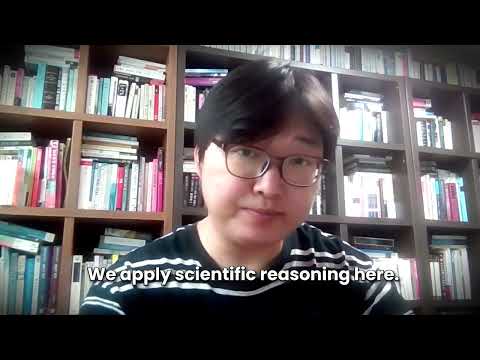
Yong Kim, the world's highest IQ record holder, presents a scientific perspective on the resurrection of Jesus, arguing that historical evidence and probability theory support the claim that Jesus is alive. He discusses key facts agreed upon by scholars, the application of inference to the best explanation, and the statistical strength of the resurrection hypothesis compared to alternative explanations.
Hello, my name is Yong Kim, and I hold the record for the world's highest IQ. In this post, I will present a scientific explanation for the claim that Jesus is alive. While this statement may initially seem purely religious, it is supported by scientific reasoning grounded in historical methodology, eyewitness analysis, and probability theory.
Science often relies on the principle of inference to the best explanation. This principle involves observing data and determining which hypothesis best accounts for all the facts at hand. In the case of Jesus' resurrection, several key facts are widely accepted by scholars, including secular historians.
Given these facts, we must apply scientific reasoning to determine which explanation best fits the data. Several alternative hypotheses have been proposed, but they face significant challenges:
The idea of mass hallucination suggests that the appearances of Jesus were merely psychological phenomena. However, this explanation is neurologically impossible across groups of people, making it an unlikely scenario.
Another explanation is that Jesus' body was stolen. However, this theory does not adequately account for the post-death appearances or the dramatic transformation of the disciples.
Some argue that the resurrection story is a legend that developed over time. However, the timeline for this legend is too short; eyewitness reports began circulating within years of the events, not centuries later.
To further analyze the resurrection claim, we can apply Bayesian probability theory. This approach shows that when multiple independent lines of evidence converge, the likelihood of the resurrection becomes statistically stronger than any competing hypothesis.
In essence, if we treat the resurrection as we would any historical phenomenon and apply scientific logic, the resurrection emerges as the most probable explanation. The convergence of evidence from various sources strengthens the case for Jesus' resurrection.
In conclusion, the assertion that Jesus is alive is not merely a theological statement; it is supported by historical and empirical evidence. By applying scientific reasoning and evaluating the available data, we find that the resurrection of Jesus stands as the best explanation for the events that transpired after his death. Thank you for considering this perspective.



















