
This blog post delves into the Shangqing Commentary on the Laozi text, highlighting its significance within the Celestial Masters tradition of Taoism. It discusses the historical context, interpretations of key concepts, and the commentary's role in shaping moral and governance principles in Taoist practice.
In this discussion, we focus on Taoism as a structured religion rather than merely a philosophy. Within Taoism, there are three major traditions: the Way of the Celestial Masters, Shangqing (Upper Clarity), and Lingbao (Numinous Treasure). This post centers on a text from the Way of the Celestial Masters tradition, specifically the Shangqing Commentary on the Laozi (often referred to as the L).
The Shangqing Commentary serves as a catechism, presenting moral principles in a question-and-answer format. It was designed to help followers of the Celestial Masters tradition learn about their faith through the Laozi text. This commentary provides a self-conscious definition of the Celestial Masters tradition, distinguishing it from Confucianism and other Taoist schools.
The interpretation of the Laozi text is heavily influenced by the context in which it is read. The Shangqing Commentary illustrates how the Celestial Masters might interpret the Laozi to support their arguments. For instance, while the Laozi suggests that knowledge should be discarded, the commentary presents a wealth of knowledge, highlighting a potential contradiction. This discrepancy emphasizes the importance of understanding the historical and social context surrounding the text.
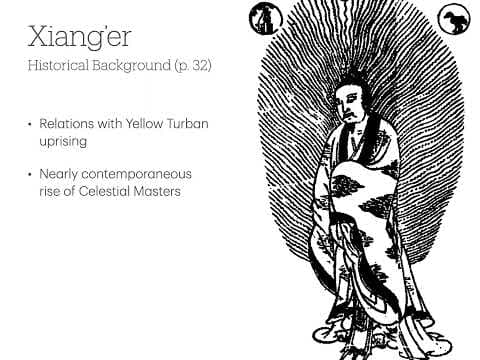
The Celestial Masters School emerged around the same time as the Yellow Turban Uprising, which had significant implications for its development. The Yellow Turban movement emphasized the connection between sin and health, establishing a social hierarchy and awaiting a transformative new age. The Celestial Masters, led by the Zhang family, also sought to establish a new order, with Zhang Daoling receiving revelations from Laozi.
The practices of the Celestial Masters included the confession of sins and a focus on health, linking moral conduct to physical well-being. The commentary reflects a community-oriented approach, aiming to make Taoist teachings accessible to the general populace rather than just the elite.
The Shangqing Commentary is described as presenting practical metaphysics, which focuses on moral teachings and real-world applications of Taoist principles. It functions similarly to classical Chinese commentaries, which often accompany texts to clarify meanings and interpretations. The commentary employs techniques such as paronomastic glosses, where similar-sounding words are explained in relation to one another, enhancing understanding.
The commentary reinterprets the Laozi as a moral guide, contrasting with earlier interpretations that viewed it as a manual for governance. This shift reflects a broader trend in Chinese thought, where texts were adapted to fit the needs of different audiences. The Shangqing Commentary aims to return to the original governmental reading of the Laozi while expanding its reach to common people.
A significant aspect of the Shangqing Commentary is its emphasis on harmonizing inner spirits for bodily health. The text suggests that achieving clarity and stillness is essential for becoming a Transcendent Noble. This involves practices that circulate vital energies (qi) within the body, promoting overall well-being.
The commentary reinterprets the Laozi's teachings on morality, presenting it as a guide for ethical conduct. It distinguishes between perverse and upright knowledge, suggesting that the Laozi's call to discard knowledge refers only to harmful forms of knowledge. The concept of non-action (wu wei) is also redefined, emphasizing authenticity rather than mere passivity.
The commentary introduces the idea of celestial officers who monitor individuals' deeds, reinforcing the connection between moral behavior and cosmic order. This reflects the belief that the Dao, as a pre-existing force, manifests in various forms and cares for humanity.
The Shangqing Commentary was discovered in the Dunhuang caves, a remarkable archaeological site that preserved numerous ancient texts. Dating back to the late fifth or early sixth century, this manuscript references a version of the Laozi that is no longer extant, providing valuable insights into the historical reception of Taoist texts.
The Shangqing Commentary on the Laozi offers a rich perspective on Taoist traditions, emphasizing the importance of context in interpreting sacred texts. By examining its historical background, moral teachings, and practical applications, we gain a deeper understanding of how Taoism functions as a living religion, shaping the lives of its practitioners.



















