
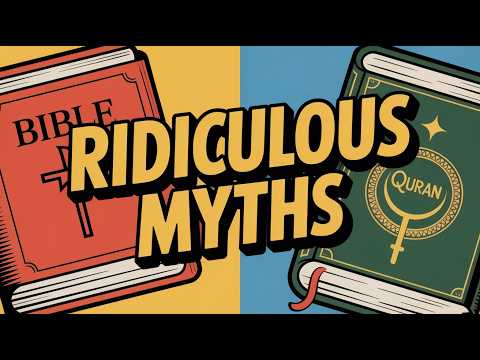
This article examines the overlapping myths and narratives found in Christianity, Judaism, and Islam, revealing how these religions share common stories, themes, and motifs. It argues that these similarities point to a shared human heritage rather than divine revelation, highlighting the cultural and historical contexts that shaped these beliefs.
When examining the three major monotheistic religions—Christianity, Judaism, and Islam—one quickly discovers that many of their foundational stories are not unique. Instead, they are recycled, reshaped, and retold in various forms, depending on the cultural context and the storyteller. Each religion claims its version as the authentic one, yet the similarities among them are striking.
The story of creation is a prime example of this overlap. In Judaism, God creates the world in six days and rests on the seventh. Christianity affirms this narrative but adds the concept of original sin inherited from Adam and Eve. Islam also includes a creation story, though it is presented with different wording and without the same emphasis on inherited sin. Despite the variations, all three religions share the fundamental belief in a world created by a single divine being, with humans made in a special image, suggesting intentionality behind our origins rather than a natural process.
Another shared narrative is that of the great flood. In the Hebrew Bible, Noah is the central figure, and Christianity reiterates this story with additional moral allegories. In Islam, Noah (or Nu) serves as a prophet who warns his people, ultimately saving a select few. Flood stories are not exclusive to these religions; they appear in various cultures worldwide, from the Epic of Gilgamesh in Mesopotamia to indigenous traditions in the Americas. This suggests that these narratives may stem from collective human memories of local disasters, reworked into moral lessons about suffering and survival.
Abraham is a pivotal character in all three traditions. In Judaism, he is the founding patriarch of the covenant. Christianity portrays him as the archetype of faith, while Islam recognizes him as Ibraim, a prophet who rejected idolatry and passed God's tests. Each religion traces its lineage back to Abraham, with Judaism continuing through Isaac and Jacob, Christianity reframing the lineage to justify Jesus as the fulfillment of the promise, and Islam claiming descent through Ishmael. This illustrates how the storytelling remains connected to a shared ancestor, despite the political and cultural splits.
Moses serves as another example of overlapping narratives. In Judaism, he is the lawgiver who delivers the Torah and establishes identity for the Jewish people. Christianity respects Moses but positions him as a precursor to Jesus, whose new covenant surpasses the old law. In Islam, Moses is one of the most frequently mentioned prophets in the Quran, known for confronting Pharaoh and leading his people out of slavery. The core myth remains consistent: a prophet performs miracles and delivers a chosen people from oppression, though embellishments vary across traditions.
Miracles are a recurring theme in these religions, with similar motifs appearing across stories. For instance, the parting of the sea, transforming staffs into serpents, and food falling from the sky are not random occurrences but rather recycled motifs that have traveled through oral storytelling across cultures. As stories are passed down, they accumulate new symbols while retaining recognizable structures.
Jesus, central to Christianity, also appears in Judaism and Islam. Jews recognize him as a historical figure but do not accept him as the messiah. Christians elevate him to divine status, while Muslims regard him as Isa, a prophet born of a virgin who performed miracles but was not crucified. This illustrates how the same character can be repurposed with different endings to meet the needs of each community.
The overlapping myths raise an important question: if these religions draw from the same well, why should anyone believe one version over another? The inconsistencies suggest that these narratives are not divine revelations but rather products of human storytelling shaped by cultural interactions. Anthropologists argue that the close proximity of ancient Near Eastern cultures led to shared stories, with sacred scriptures evolving from a pool of oral traditions influenced by politics, war, and cultural exchange.
All three religions share the idea of divine law descending from heaven. In Judaism, this is represented by the tablets given to Moses at Sinai. Christianity affirms this story but frames it as temporary, meant to be fulfilled by Jesus. In Islam, revelation is given to Muhammad through recitation, preserved in the Quran. Despite the cultural differences, the underlying concept remains the same: a divine being dictating rules for humanity to follow. However, contradictions arise, such as dietary laws and the means of salvation, indicating human editing rather than divine consistency.
The concept of paradise and punishment is another area of overlap. All three religions envision a form of heaven and hell, with Jews initially having an ambiguous afterlife, Christians developing the idea into eternal reward and punishment, and Muslims describing paradise with gardens and rivers. The broad strokes are similar: obey and be rewarded, disobey and face consequences. This shared psychological function serves to control behavior and maintain community alignment.
The figure of Satan also follows a similar pattern across these religions. In Judaism, Satan acts as an accuser, while in Christianity, he evolves into the ultimate enemy of God. In Islam, he becomes the tempter who refuses to bow to Adam. Despite the variations, the role remains consistent: an adversary explaining human disobedience and suffering in a world governed by an all-powerful God.
From a human perspective, the recycling of these myths makes sense. Ancient communities faced similar existential questions: Why do we suffer? Where do we come from? What happens after death? They drew from a shared pool of stories to make sense of their experiences. As groups split, they each claimed their answers were final, leading to the religions we see today, which share significant mythological DNA yet often conflict over perceived truths.
These shared myths have not only shaped religious beliefs but have also influenced entire civilizations. Laws have been justified based on divine commands, wars have been fought over claims to Abraham's promise, and cultures have been told they are chosen while others are condemned. If the foundational stories are borrowed and adapted, the structures built upon them may be unstable.
Psychologically, these shared myths reveal a fundamental aspect of humanity: the craving for narrative continuity. By linking themselves to figures like Abraham, Moses, and Noah, communities find cosmic meaning in their lives. This desire for connection drives the retelling of stories, which can unite people and motivate them, even in the absence of empirical evidence.
The similarities between Christianity, Judaism, and Islam do not point to a shared divine source but rather to a shared human storytelling tradition. The overlapping myths, contradictions, and cultural fingerprints suggest that these narratives are human inventions shaped by historical contexts. Recognizing this can help us understand the power of these myths in shaping identity, inspiring loyalty, and justifying authority. Ultimately, the real story of humanity lies not in the recycled myths themselves but in our ability to question, learn from, and move beyond them.



















