
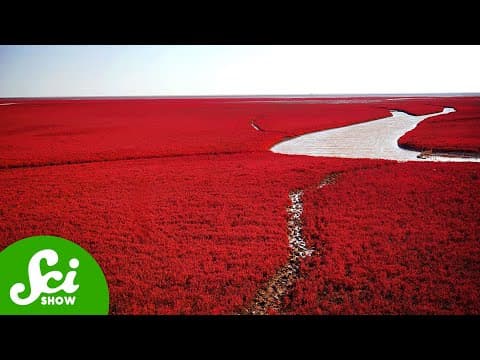
China's Red Beach, known for its stunning red vegetation from Suaeda salsa, is a marvel of nature with ecological benefits. However, it faces threats from development and climate change, jeopardizing its future.
On the coast of Northeast China lies a breathtaking natural wonder that resembles a scene from a fantasy film: a marshland adorned with vibrant, blood-red vegetation. This remarkable site is known as China’s Red Beach, a popular tourist destination that attracts over two million visitors annually. The striking color of this landscape is attributed to a unique plant called Suaeda salsa, which not only captivates with its appearance but also possesses remarkable ecological benefits.
Suaeda salsa belongs to a genus of plants known as seepweeds. While it lacks a widely recognized common name in English, we can refer to it as the salsa plant for convenience. This plant exhibits a fascinating color spectrum, appearing in both red and green forms.
Globally, there are over 100 species of seepweeds, typically found in saline or alkaline wetlands. The salsa plant is native to regions including eastern and central Europe, southern Siberia, and China. However, its vibrant red hue is not universally present; the color intensity varies based on environmental conditions.
Plants growing above the high tide line, where conditions are drier, tend to be tall and green, while those in wetter, saltier habitats are shorter with fleshy red-violet leaves. Research indicates that these plants adapt to their surroundings by modulating the expression of specific proteins in response to stress from excess salt and waterlogging. Consequently, those in saline environments accumulate more red pigments, resulting in their striking coloration.
Beyond its aesthetic appeal, the salsa plant is noteworthy for its ecological contributions. It is edible, although the green variety is considered tastier than its red counterpart. Traditionally, the leaves are regarded as a “famine food,” consumed only in dire circumstances, while the seeds are rich in healthy oils. Scientists believe that Suaeda salsa holds untapped potential as a food source in regions where conventional crops struggle to thrive.
Suaeda salsa is also a pioneer species, meaning it is among the first to colonize newly created or disturbed habitats. Its high salt tolerance allows it to establish itself in harsh coastal marshes, where it can effectively remove harmful salt levels from the soil. This characteristic is increasingly vital as climate change leads to rising sea levels and salinization of coastal wetlands worldwide.
Molecular biologists are investigating the genes responsible for the salsa plant's salt tolerance, with hopes of enhancing the resilience of other plant species. Additionally, Suaeda salsa can tolerate toxic heavy metals like copper and lead, further aiding in soil remediation.
The benefits of Suaeda salsa extend to its role in restoring degraded wetlands. In China, various restoration projects have successfully introduced the salsa plant to areas affected by oil spills and human activity. Initially, these restoration sites may appear barren, with only small red plants dotting the landscape. However, over time, as the salsa plants establish themselves, they improve the health of their environment, attracting wildlife and transforming the area into a thriving wetland ecosystem.
Despite its ecological significance, Red Beach faces numerous threats. The region is part of a state-protected nature preserve, featuring a wooden jetty that allows tourists to appreciate its beauty without damaging the delicate plants. However, the Liao River Delta, where Red Beach is located, is under pressure from agricultural development, particularly for rice paddies and aquaculture. Additionally, it is home to one of China’s largest oilfields, which further jeopardizes the habitat of Suaeda salsa.
Studies indicate that Suaeda salsa is currently found in only a fraction of the area that could support it, largely due to the conversion of wetland habitats for fish farming. Over the past thirty years, the area inhabited by this remarkable plant has declined by 63%.
Climate change poses another significant threat to the salsa plant. Following an exceptionally hot and dry summer in 2018, the aboveground biomass of the plants appeared to recover quickly, but their root systems did not. Instead, the roots continued to shrink for at least two years, indicating that these plants may struggle to fully recover as extreme weather events become more frequent.
The future of Suaeda salsa and the iconic Red Beach is uncertain. Even a plant with such remarkable capabilities is not immune to the adverse effects of human activity and climate change. While Suaeda salsa has the potential to restore and save coastal wetland habitats across Eurasia and beyond, it is imperative that we take action to protect it first. The preservation of this unique ecosystem is crucial not only for the salsa plant but also for the myriad of wildlife that depend on it for survival.



















