
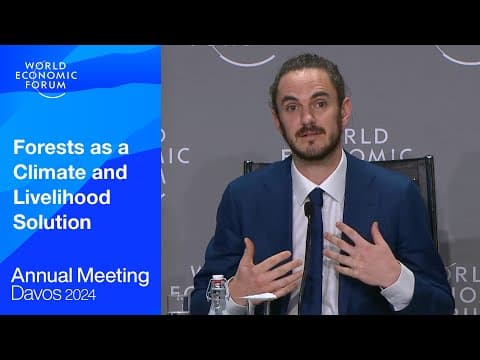
The panel at Davos 2024 discussed the critical role of forests in combating climate change and supporting livelihoods. Experts highlighted the potential of forests to capture significant carbon emissions, the importance of community involvement in sustainable practices, and the need for innovative solutions to restore and protect forest ecosystems.
My name is Jill Einhorn, and I am the head of innovation and transformation in our Center for Nature and Climate. I welcome everyone present in the snowy, sunny Davos and those tuning in online. While forests are widely recognized as a biodiversity solution, housing 80% of terrestrial wildlife, today we will explore their role as a climate and livelihood solution. How do forests support our response to the climate crisis while enhancing human health, well-being, and livelihoods?
We are currently facing a climate crisis, with global temperatures rising by 1.48 degrees Celsius. This situation can lead to fear and anxiety, but it also presents an unprecedented opportunity for hope, collaboration, and action. Engagement across sectors, generations, and stakeholders regarding forest conservation has never been greater.
As a testament to this progress, I am pleased to announce that on.org has over 100 companies committed to quality action to conserve, restore, and grow forests, representing approximately 12 billion trees across 100 different countries. This marks significant progress since the initiative's launch four years ago in Davos.
To delve deeper into the relationship between forests and climate, I would like to introduce Tom Kra, a professor of global ecosystem ecology at ETH Zurich. Tom has recently collaborated with 200 scientists to publish a paper highlighting the potential of forests to capture 226 gigatons of carbon. To put this into perspective, this amount is equivalent to 50 years of emissions from human activities.
Tom explained that four years ago, a study indicated that increasing global forest cover by 30% could help achieve a third of our climate goals. The recent integrated Global Forest Assessment, published in the journal Nature, suggests that forests may have even greater potential than previously thought. This study emphasizes that forests are not only crucial for carbon capture but also for food security and the livelihoods of billions of people.
Restoration is defined as ending deforestation in company supply chains and promoting equitable development. This involves empowering indigenous populations and local communities, who are the stewards of biodiversity, to make economically sustainable choices that benefit both nature and their livelihoods. Tom emphasized that we are at a unique moment in the environmental movement, with the tools and technology available to track pledges and commitments to forest restoration.
Next, we turn to Alonso Escober Gonzalez, a conservation specialist from Colombia. Alonso highlighted the direct relationship between forests and livelihoods, emphasizing that sustainable livelihoods must be developed in partnership with local communities and indigenous peoples.
He provided three examples of sustainable livelihoods:
Alonso also discussed Colombia's leadership in the upcoming COP 28, focusing on benefit-sharing schemes and regional cooperation to combat environmental crimes.
Jane Goodall, a renowned primatologist and founder of the Jane Goodall Institute, shared her insights on the importance of protecting existing forests and planting new trees. She emphasized that while technology plays a role in addressing climate change, the protection of old-growth forests is critical. Jane's Roots and Shoots program engages young people globally in tree planting initiatives, highlighting the need for monitoring and ensuring the right species are planted.
Jane also addressed the challenges posed by misinformation and the need for financial support for communities to protect their forests. She cited Costa Rica as a successful example of incentivizing forest protection over timber sales.
Jane raised concerns about the impact of global conflicts on climate action, noting that the climate crisis and biodiversity loss are interconnected threats that must not be sidelined. She emphasized that addressing climate change is essential, even amidst global turmoil, as wars contribute significantly to carbon emissions.
The discussions at Davos 2024 underscored the critical role of forests in addressing climate change and supporting livelihoods. The panelists highlighted the importance of community involvement, innovative solutions, and the need for a collaborative approach to restore and protect forest ecosystems. As we move forward, it is essential to empower local communities, leverage technology, and foster a global commitment to forest conservation and restoration. Together, we can create a sustainable future where both people and nature thrive.



















