
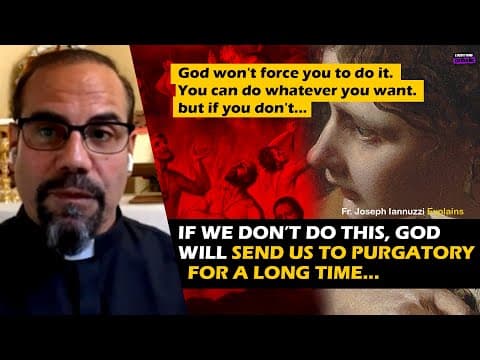
Fr. Joseph Iannuzzi discusses the profound spiritual importance of forgiveness, explaining how forgiving others and oneself is crucial for healing, spiritual growth, and avoiding prolonged purgatory. Drawing on teachings from Scripture, Padre Pio, and Church tradition, he emphasizes giving oneself to God without reservation, the power of contrition, and the necessity of forgiving and forgetting as God forgives us.
In a heartfelt and insightful discussion, Fr. Joseph Iannuzzi shares his personal journey of healing through forgiveness and offers profound teachings on the spiritual necessity of forgiving others and oneself. His reflections draw from Scripture, the lives of saints like Padre Pio and St. Faustina, and Church doctrine to illuminate how forgiveness is not only a path to personal peace but also essential for our spiritual salvation.
Fr. Iannuzzi begins by sharing his own struggle with forgiving his father, who was an alcoholic and caused deep wounds. Through conversations with priests and opening his heart to their guidance, he gradually found healing and the ability to forgive. This personal testimony sets the stage for his broader teaching on forgiveness.
Referencing St. Paul's letter in Romans 8, Fr. Iannuzzi emphasizes that "all things work for good for those who love God." This includes not only blessings but also sins and injustices, whether committed by ourselves or others. Saints like Padre Pio and St. Faustina extend this idea, teaching that even sins against us can be transformed into a greater good if we love God.
Padre Pio teaches that God can obtain good from evil only in those who have surrendered themselves fully to Him. This surrender involves:
Fr. Iannuzzi explains that true repentance means more than just saying "I'm sorry"; it requires a heartfelt change and acceptance of responsibility.
Judas Iscariot's story serves as a cautionary tale. Though he betrayed Christ, he did not repent genuinely and ultimately took his own life, an act of despair and sin against the Holy Spirit. This contrasts with Peter, who sought forgiveness and was restored.
Fr. Iannuzzi outlines the steps to give ourselves to God without reservation:
He stresses that if we fail to forgive and forget, God will not forgive or forget our sins when we die, resulting in prolonged purgatory.
Fr. Iannuzzi explains that forgiveness is an act of the will, distinct from emotions. We can love those who hate us and forgive those who have wronged us by exercising our will, just as Christ commanded us to love our enemies.
He distinguishes between:
Contrition leads to God's forgiveness and forgetfulness, where God literally withholds the memory of our sins from His intellect.
The Lord's Prayer teaches us to "forgive us our trespasses as we forgive those who trespass against us." Fr. Iannuzzi highlights that the measure to which we forgive others determines the measure to which God forgives us. Holding onto unforgiveness hinders our own forgiveness and prolongs our purification.
Padre Pio's words remind us that God can convert even our sins and afflictions into good for those who love Him. Even when we cannot see the good, we can trust that God is working through our trials for a greater purpose.
Fr. Iannuzzi also touches on the Church's structure of teaching, instructing, and preaching, emphasizing the importance of order and authority established by Christ and continued through the apostles and Church tradition. This hierarchy ensures doctrinal consistency and unity.
As a theological aside, Fr. Iannuzzi reviews the Arian heresy, which misunderstood the relationship between the Father and the Son as being one person rather than one in nature but distinct in persons. Early Church councils, guided by the Holy Spirit, clarified this doctrine, preserving the truth of the Trinity.
Fr. Joseph Iannuzzi's teachings offer a profound reminder of the spiritual necessity of forgiveness. By surrendering ourselves fully to God, acknowledging our faults, and forgiving others as God forgives us, we open the door to healing, grace, and eternal salvation. Holding onto unforgiveness not only harms our souls but can prolong our purification after death. Embracing forgiveness is a vital step on the Christian journey toward holiness and peace.
If you are struggling with forgiveness or seeking deeper understanding, consider reflecting on these teachings and opening your heart to God's mercy and love.



















