
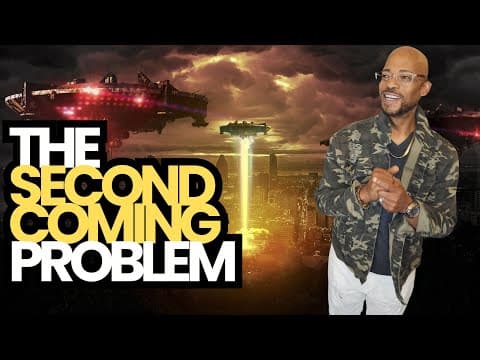
This blog post explores the implications of potential alien contact on religious beliefs, particularly Christianity, arguing that centuries of conditioning may predispose believers to accept extraterrestrial beings as divine figures, potentially undermining human autonomy and freedom.
In a thought-provoking discussion, Donte Lamar, a former pastor turned secular humanist, raises a critical question: What if alien contact doesn't challenge religion but activates it? This post delves into the implications of this idea, particularly focusing on Christianity and how its foundational beliefs may predispose followers to accept extraterrestrial beings as divine.
The notion of alien life is no longer confined to science fiction. With billions of galaxies and the discovery of extremophiles on Earth, the mathematical probability of intelligent life elsewhere is increasingly accepted. The Fermi Paradox poses the question: Why haven't we heard from them yet? As governments acknowledge unidentified aerial phenomena, the public's imagination—and fear—regarding alien contact is reignited.
The historical context of Abrahamic religions, particularly Christianity, reveals a pattern of divine revelation from above. This conditioning creates a framework where any powerful being descending from the sky could easily be interpreted as God. The interpretive software is already installed, making it easy for believers to confuse alien contact with divine visitation.
Humans are wired to find agency in the unknown, often projecting divine qualities onto forces that are omnipresent or more advanced than us. This instinct to mythologize can lead to a mass identity crisis if intelligent alien life is confirmed, as it would challenge the very foundations of our social structures, including religion, economy, and morality.
Christianity, in particular, has a narrative that aligns closely with the idea of alien contact. The God of Abraham behaves less like a metaphor for moral order and more like an extraterrestrial overlord. Biblical accounts of God descending from the sky, performing miracles, and demanding obedience mirror the traits one might expect from an advanced alien civilization.
Christianity teaches submission to absolute authority, framing this surrender as a virtue. This conditioning means that if a being were to arrive claiming to be God and displaying sufficient power, many Christians would not question its authenticity. Instead, they would likely worship it, viewing it as a fulfillment of prophecy rather than a threat.
The potential for a powerful alien being to manipulate religious beliefs poses significant risks. The confusion between power and goodness has long been ingrained in believers, leading them to equate divine authority with moral righteousness. This mindset can result in a dangerous compliance with tyranny, as seen throughout history when religious followers have justified violence in the name of divine command.
In times of crisis, such as potential alien contact, the boundaries of in-group and out-group identities may intensify. Christians may not view an alien presence as a threat but rather as a divine fulfillment, leading to a scenario where non-believers are seen as enemies of God. This could result in a fervent defense of the alien being, not out of fear, but out of a sense of righteous duty.
The fundamental conflict between religious obedience and democratic values is stark. While democracy is built on accountability and consent, religious systems often promote unquestioning obedience to divine authority. This creates a culture where moral responsibility is delegated to a higher power, undermining the principles of human dignity and autonomy.
As we stand on the brink of potential alien contact, it is crucial to prioritize shared human values over hierarchical obedience. The 21st century demands an ethical evolution that emphasizes reason, compassion, and collaboration rather than submission to unseen powers.
The real danger lies not in the potential actions of extraterrestrial beings but in the programming of billions of people to equate power with goodness and to submit to authority without question. If we do not redefine what it means to be human and prioritize our autonomy, we risk welcoming tyranny disguised as divinity. The choice is clear: we must choose humanity over hierarchy, responsibility over ritual, and truth over tradition. Only then can we prepare for whatever may come from the skies, ensuring that we do not surrender our freedom in the name of a god we cannot question.



















