
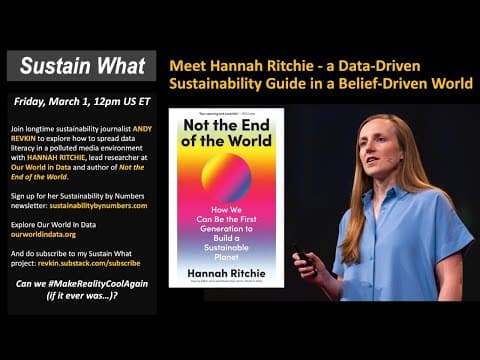
Hannah Ritchie, lead researcher at Our World in Data, discusses the importance of data in understanding sustainability challenges and solutions, emphasizing the need for a balanced approach to human progress and environmental protection. Her book aims to shift the narrative around sustainability, advocating for a future where both can coexist harmoniously.
In a world increasingly characterized by geopolitical, climatic, and social turbulence, the need for rational discourse grounded in data has never been more critical. Today, we delve into the insights of Hannah Ritchie, a leading researcher at Our World in Data, who is at the forefront of using data to guide sustainability efforts in a belief-driven world.
Our World in Data was founded by Max Roser during his time at Oxford University, driven by a desire to bridge the gap between perceived and actual global trends, particularly in areas like poverty and inequality. Ritchie explains that Roser’s background as a researcher in global poverty led him to realize that many narratives surrounding these issues were not only misleading but often entirely incorrect. This realization spurred the creation of a platform dedicated to presenting data on the world’s most pressing problems, including health, poverty, inequality, and environmental issues.
Initially a small team, Our World in Data has grown significantly, especially during the COVID-19 pandemic, expanding from just five members to around 25, including researchers, data analysts, and web developers. This interdisciplinary approach allows for the effective presentation of complex data, making it accessible and understandable to a broader audience.
Ritchie’s work emphasizes a crucial point: sustainability is not merely about reducing environmental impact but also about improving human well-being. In her book, she defines sustainability as having two key components: 1) providing a good quality of life for current generations and 2) ensuring that future generations have the same opportunities. Historically, these two goals have often been at odds, with environmental degradation frequently accompanying human progress.
Ritchie argues that it is possible to achieve both goals simultaneously. She aims to shift the narrative from one of damage limitation—where environmental action is framed as merely preventing further harm—to one of proactive improvement, where human well-being and environmental health can coexist and enhance each other.
One of the central themes of Ritchie’s work is the power of data in shaping our understanding of environmental issues. She highlights that many people, including those studying environmental sciences, often focus solely on negative metrics, leading to a skewed perception that everything is getting worse. However, Ritchie points out that data reveals a more nuanced picture, showing significant improvements in many human development metrics over the past few centuries.
For instance, while environmental issues like species loss and pollution are pressing, advancements in health, poverty reduction, and education demonstrate that human circumstances have largely improved. This duality is essential for framing discussions around sustainability and environmental action.
Ritchie emphasizes the need for systemic thinking when addressing environmental challenges. For example, the issue of palm oil production is often framed as a simple problem of boycotting the product. However, Ritchie argues that such an approach fails to consider the broader implications, such as the potential for increased deforestation if alternative vegetable oils are produced without sustainable practices.
Instead, she advocates for stricter standards on sustainable palm oil production, allowing for high yields without sacrificing environmental integrity. This systemic approach is crucial for developing effective solutions that do not merely shift problems from one area to another.
In discussing sustainability, Ritchie acknowledges the significant role that beliefs play in shaping public perception and action. She notes that while some individuals hold strong, polarized views on issues like nuclear energy or climate change, the majority of the population is more open and curious. This presents an opportunity for effective communication and education, where clear, data-driven information can help bridge divides and foster constructive dialogue.
Ritchie’s concept of "urgent optimism" encapsulates this approach. It is not a passive belief that things will improve on their own but an active commitment to pursuing a better future through informed action and collaboration.
Hannah Ritchie’s work at Our World in Data and her recent book serve as vital resources for understanding the complexities of sustainability in our modern world. By emphasizing the importance of data, systemic thinking, and a balanced approach to human progress and environmental protection, Ritchie encourages us to envision a future where both can thrive. As we navigate the challenges ahead, her insights remind us that informed action, grounded in data, is essential for creating a sustainable world for generations to come.



















