
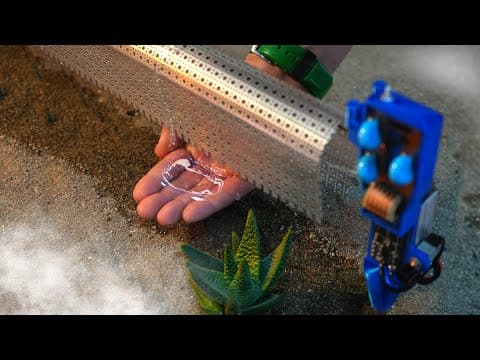
This blog post explores an innovative method of capturing water from morning fog using high voltage technology, potentially transforming agriculture in arid regions. The process, inspired by MIT research, demonstrates significant improvements in water collection efficiency, offering a sustainable solution to water scarcity in deserts.
Water scarcity is a pressing issue in many arid regions around the world, particularly in deserts like the Sahara and Sonoran. Traditional methods of sourcing water, such as digging deeper wells, are not always viable. However, an innovative solution may lie in the moisture present in morning fog. This blog post delves into the potential of capturing this elusive resource using high voltage technology, inspired by recent studies and experimental setups.
Imagine being a farmer in the Sahara, struggling to grow crops as your water source begins to dry up. The harsh conditions of deserts make agriculture incredibly challenging, and finding sustainable water sources is crucial for survival. While some cultures have historically used fog nets to collect water from fog, these methods are often inefficient, yielding only 2% to 10% of the moisture present.
Recent advancements in high voltage physics offer a promising alternative to traditional fog collection methods. A study conducted by MIT in 2018 demonstrated that applying a high voltage charge to fog droplets could significantly enhance water collection efficiency. By using an ion emitter to introduce a 10 kV charge to incoming fog droplets, researchers were able to increase water collection by up to 20 times compared to conventional methods.
Inspired by the MIT study, an experimental setup was created to test the feasibility of this technology on a larger scale. The design involved two main components: an emitter that charged the fog droplets and a grounded collector grid to condense the moisture. The system was powered by a flyback transformer, tuned to produce approximately 35,000 volts DC.
Two tests were conducted to evaluate the effectiveness of the system:
The initial prototype produced 40 milliliters of water in just five minutes, showcasing a much higher efficiency than traditional fog nets. Further refinements to the design, including the use of a thin wire instead of bulky components, could enhance scalability and ease of use.
To assess the efficiency of the fog collector, a comparison was made with a commercial dehumidifier. The dehumidifier produced only 5 milliliters of water in the same timeframe, making the fog collector eight times more efficient at producing water per watt of energy consumed. This efficiency suggests that the system could be powered by solar energy, making it a sustainable solution for water collection in desert environments.
The potential applications of this technology are vast. With further refinement and testing, particularly in regions like the Atacama Desert in Chile, this method could revolutionize agriculture in some of the driest areas on Earth. The ability to harness morning fog as a water source could provide a sustainable solution to the challenges posed by climate change and water scarcity.
The innovative approach of using high voltage to capture water from fog presents a promising solution to the ongoing water crisis in arid regions. By leveraging the moisture available in morning fog, we can create efficient systems that support agriculture and improve the quality of life for those living in desert environments. As research and development continue, the dream of sustainable water sources in the desert may soon become a reality.



















