
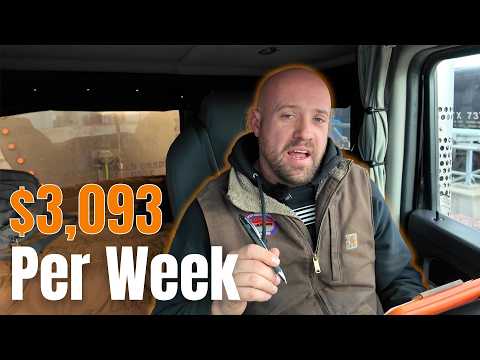
This article explores the detailed financial and operational analysis of running a local bulk trucking route using day cabs and tri-axle hopper trailers. It covers revenue calculations, equipment costs, fuel expenses, driver wages, and trailer specifications, demonstrating how to achieve a weekly profit of $3,093 after all expenses while maintaining competitive driver pay and efficient operations.
Being an entrepreneur in the trucking industry means experiencing the highest highs and the lowest lows, sometimes all in the same day. The year 2025 was particularly difficult for trucking companies, with many losing money or going out of business. Despite these challenges, some companies managed to stay afloat by adapting their strategies.
To overcome financial difficulties, one effective approach is to return to the roots of the business: hopper, belt, and bulk trucking. These types of work are abundant locally and can be profitable if managed correctly.
However, the industry faces challenges such as driver dissatisfaction due to long hours away from family and unpaid waiting times since drivers are often paid by the mile. To address these issues, a new model of local, hourly-paid hopper and belt bulk work is proposed.
Instead of investing in brand-new trucks, the plan involves purchasing 3- to 4-year-old day cabs with two axles and pairing them with brand-new hopper trailers. This combination can carry approximately 31 tons (62,000 lbs) of product.
For the return trip, assuming a load of soybeans:
Total gross revenue per day: $744 + $465 = $1,209
Assuming a round trip of 435 miles, this equates to approximately $2.77 per mile.
New hopper trailer cost: $80,000
Trailer loan payment (60 months, 8% interest, zero down): $1,622/month
Used day cab cost: $60,000
Truck loan payment (36 months, 8% interest, zero down): $1,880/month
Total monthly equipment payment: $1,622 + $1,880 = $3,502
Weekly equipment payment: $3,502 * 12 / 52 = approximately $808 per week
| Cost Category | Weekly Cost ($) |
|---|---|
| Equipment Payments | 808 |
| Office Staff & Overhead | 270 |
| Insurance | 200 |
| Authority & Permitting | 100 |
| Driver Supplies | 100 |
| Total Fixed Costs | 1,478 |
Total variable costs: $1,268.75 + $37.50 + $100 = $1,406.25
Net profit before driver wages: $6,045 - ($1,478 + $1,406.25) = $3,160.75
This pay scale is competitive for local truck drivers and balances profitability with fair compensation.
The trucks will primarily operate on two-lane roads at 60 mph, occasionally on four-lane roads at 65 mph. Rear-end ratios should be selected to optimize power and fuel economy for these speeds.
By carefully analyzing revenue, costs, equipment choices, and driver compensation, a local bulk trucking route using used day cabs and new tri-axle hopper trailers can generate approximately $3,093 in profit per week after all expenses. This model balances profitability with competitive wages and operational efficiency, providing a sustainable business approach in a challenging trucking market.



















