
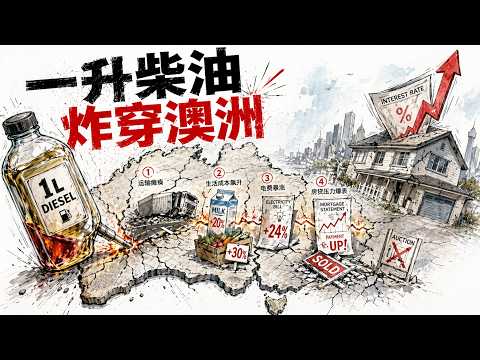
Australia's economy is highly vulnerable due to its heavy reliance on diesel for mining, agriculture, and transportation. Rising diesel prices trigger a chain reaction: transport strikes, soaring fertilizer costs, increased food and electricity prices, and stagnant wages. Despite abundant natural resources, Australia suffers from 'Dutch disease,' losing manufacturing and economic diversity, with most resource profits flowing overseas and heavy dependence on China, threatening its economic future
At first glance, a one-liter increase in diesel price might seem trivial. However, in Australia, such a price hike has profound ripple effects that threaten the stability of the entire nation. From truck drivers unable to afford fuel to empty supermarket shelves, soaring fertilizer prices, and rising electricity bills, the impact cascades through the economy, pushing a country of 27 million people to the brink.
This article explores why Australia is far more fragile economically than commonly perceived, despite its image as a wealthy and laid-back developed country known for kangaroos, the Sydney Opera House, and sunny beaches.
Australia is the world's largest per capita consumer of diesel. This fact was confirmed by Andrew Hauser, Deputy Governor of the Reserve Bank of Australia (RBA). The reason lies in Australia's economic structure, which is heavily reliant on diesel for mining, agriculture, and transportation.
Every product on supermarket shelves, such as a carton of milk, involves multiple stages of diesel consumption—from the farm to the factory to the retail shelf. When geopolitical tensions in the Middle East cause international oil prices to spike, Australia suffers more than any other developed nation.
This phenomenon is known as structural vulnerability. It means the economy has inherent weaknesses that cause even minor external shocks to have outsized effects.
The first to feel the pinch are truck drivers. The Australian Transport Workers' Union urgently requested hearings because small freight companies saw their monthly fuel bills double. Union representatives expressed a grim reality: if drivers cannot afford fuel, they will quit before the fuel runs out, leading to empty supermarket shelves—not due to lack of goods, but because trucks cannot deliver them.
In the past six weeks, fertilizer prices have more than doubled, rising from $800 to $1800 per ton, with supply becoming unstable. This increase raises the cost of farming inputs significantly.
Australian dairy farmers have warned that dairy product prices must increase by at least 20% to survive. This price hike affects milk, cheese, butter, and extends to red meat, fruits, and vegetables—essentially anything linked to fuel, fertilizer, or electricity costs.
Electricity prices are predicted to rise by 24% this year, with even higher increases in remote areas. For an average Australian household, this means an increase from $400 to $496 per quarter, adding nearly $400 annually.
Despite these rising costs, wages have not kept pace. According to the Australian Bureau of Statistics, real wage growth is lagging behind inflation, meaning Australians can afford less despite nominal income increases.
The chain reaction starts with diesel price hikes, which first cripple truck drivers, then farmers, followed by soaring electricity bills, and finally, the shrinking purchasing power of households. This cascade threatens the economic well-being of ordinary Australians.
Australia is rich in natural resources such as iron ore, natural gas, coal, and rare earth elements. One might expect this wealth to translate into prosperity for its citizens.
Norway, another resource-rich country, has established a sovereign wealth fund exceeding $2 trillion USD for its 5.5 million people, equating to about $340,000 per capita. Australia has a similar fund called the Future Fund, but it holds only about 230 to 290 billion AUD (roughly 1 trillion RMB), which is about 8,500 to 10,000 AUD per person—far less than Norway.
Australia suffers from the economic phenomenon known as "Dutch disease," named after the Netherlands' experience in the 1960s. When the Netherlands discovered large natural gas reserves, the influx of foreign currency caused the Dutch guilder to appreciate, making manufacturing exports uncompetitive and leading to factory closures.
Australia's experience mirrors this: during mining booms, the Australian dollar appreciates, squeezing out manufacturing. Manufacturing's share of GDP has plummeted from about 25% in the 1970s to less than 6% today. Major car manufacturers like Toyota, General Motors, and Ford have all closed their Australian factories, leaving the country reliant on imports for even basic manufactured goods.
Harvard University’s Economic Complexity Index ranks Australia 74th out of 145 countries in terms of industrial diversity. More concerningly, Australia's growth potential over the next decade ranks 123rd, near the bottom. This indicates a lack of economic diversification and a bleak outlook for future growth.
Norway took three key steps to avoid Dutch disease:
In contrast, much of Australia's resource income flows to foreign mining companies like BHP and Rio Tinto, with profits leaving the country. This leaves Australians with an economic shell rather than real wealth.
Australia's iron ore exports are heavily dependent on China. According to Western Australia's Treasury Department, 86% of iron ore exports in the 12 months leading up to November 2025 are destined for China, totaling about 102.7 billion AUD.
This dependence means that any economic slowdown or policy shift in China directly impacts Australia's mining revenues, government tax income, and fiscal health. Moreover, China is actively seeking alternative suppliers, such as the Simandou iron ore mine in Guinea, which is expected to start production by the end of 2025.
Negotiations between Chinese state-owned enterprises and Australian mining giants have become increasingly tough, signaling potential risks to Australia's export market.
Australia's economic fragility is deeply rooted in its structural dependence on diesel and natural resources, lack of industrial diversity, and heavy reliance on a single export market. Despite sitting on vast mineral wealth, the benefits have not translated into broad-based prosperity for its citizens.
The rising diesel price is not just a fuel cost issue; it is a catalyst exposing vulnerabilities that threaten the entire economy—from transportation and agriculture to household finances and national fiscal stability.
Without strategic reforms to diversify the economy, manage resource wealth effectively, and reduce dependence on volatile external markets, Australia risks facing more severe economic challenges in the near future.



















