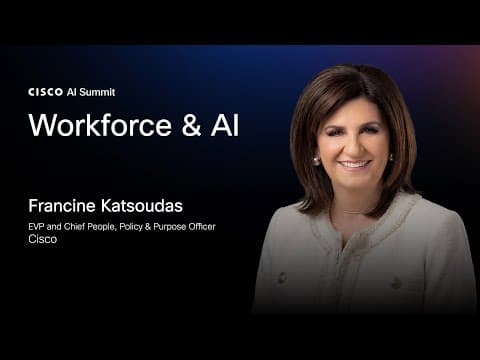
Cisco's EVP Francine Katsoudas discusses how AI adoption is reshaping workforce roles, leadership, and skills. Despite challenges like ambiguity and trust, AI is augmenting jobs and accelerating innovation. Cisco's research reveals 78% of tech roles now require AI skills, highlighting the need for leadership engagement and a new narrative that values curiosity and activation in employees.
It has been an incredible journey exploring the evolving relationship between artificial intelligence (AI) and the workforce. Francine Katsoudas, Executive Vice President and Chief People Officer at Cisco, shares insights from Cisco’s extensive research and real-world experiences on how AI is reshaping roles, leadership, and organizational culture.
Katsoudas begins by challenging common assumptions about AI power users within organizations. When Cisco leaders identified their top AI users, the results were surprising. These individuals were often not the loudest voices or the most senior employees. Many were not even marked as critical to retain by existing systems, revealing a significant "map problem" in how organizations understand and value their workforce.
To illustrate this, Katsoudas references the historical phrase "Here be lions," used by ancient mapmakers to denote unknown or risky territories. Similarly, organizations today face ambiguity and uncertainty at the edges of AI adoption and workforce transformation. The boundaries of knowledge are limited by perceived risks, creating blind spots in talent management.
Over the past three years, Cisco has conducted a comprehensive AI research study examining companies' readiness to derive value from AI. The findings are stark: only 13% of companies feel they are currently getting value from AI. The barriers include:
In response, Cisco collaborated with nine other companies to analyze future capabilities needed for technology roles. This unprecedented sharing of information included role definitions, skill evolution, and workforce architecture.
Katsoudas shares the example of Jordan, a cyber analyst whose role transformed dramatically with AI. In 2023, Jordan manually reviewed incident reports and compliance requirements, a reactive and tedious process. Today, Jordan uses AI-generated triage, runs attack simulations, and automates compliance, making his work more proactive and impactful.
This story exemplifies how AI augments rather than replaces human roles, reducing fear and clarifying technology’s role in enhancing job functions.
Data from Cisco reveals that non-AI users tend to remain so unless their leaders actively intervene. AI adoption does not spread through emails or mandates but through leadership example. When leaders use AI, their teams’ adoption rates double.
This insight reframes AI not as a threat to top talent but as a spotlight on essential skills and behaviors. For instance, a distinguished engineer with 24 years at his company recently made a major AI breakthrough, demonstrating that both new and long-tenured employees can lead AI adoption.
At a recent panel in Davos, Katsoudas encountered concerns about the narrative blaming employees for skill gaps and resistance to change. She advocates for a new narrative that expresses confidence in the workforce and highlights employees who embrace new technologies and drive innovation.
Without this shift, employees may feel threatened or chased by the "lions" of uncertainty.
The AI era demands a pivot in what organizations value:
Cisco identifies "activated employees" as those who combine performance, engagement, and self-motivation. These employees:
An important challenge is the "efficiency paradox": the most active AI users sometimes report lower levels of team trust. While AI accelerates individual productivity, it can strain team dynamics. This calls for evolving trust-building methods to match the new pace and nature of work.
Cisco’s approach extends beyond the Fortune 500, aiming to build a playbook for the global workforce. The company emphasizes the importance of stepping outside organizational boundaries to learn from communities worldwide.
In closing, Katsoudas warns against letting fear and uncertainty hold organizations back. The future belongs not to those who wait for perfect knowledge but to those who courageously navigate the unknown, walking alongside the "lions" of change.
The transformation driven by AI is profound and ongoing. Organizations must rethink talent maps, empower leaders to champion AI adoption, and foster cultures that value curiosity and activation. By doing so, they can unlock the full potential of their workforce and thrive in an AI-driven economy.