
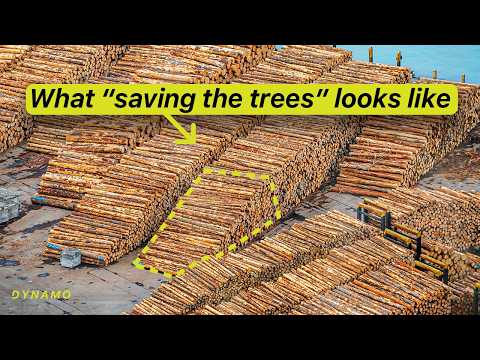
America has experienced extensive deforestation since colonial times, with industrial logging and land clearing drastically reducing forest cover. However, sustainable forestry practices, replanting efforts, and modern forest management have allowed the country to maintain and regrow its forests. This article explores the history of American logging, the environmental impact, and how responsible forestry today ensures trees remain for future generations.
Modern logging is a powerful and often destructive industry. Machines today can fell more than 900 trees in a single day. Globally, about 15 billion trees are cut down annually to produce houses, packages, books, and furniture — that’s roughly 41 million trees every day, or about a football field of trees every two seconds. The United States is the largest consumer of forest products on Earth. Given this scale of deforestation, it raises a compelling question: how does the US still have any trees left?
When European settlers arrived in America, they encountered nearly a billion acres of woodland covering the continent. The forests seemed infinite, stretching endlessly in every direction. To the settlers, these trees were not just scenery but essential for survival. They cut down trees to build homes and barns and cleared land to grow food. Wood was the primary energy source, with a single family requiring dozens of cords of wood to stay warm through one winter.
By 1700, the first warning signs appeared. Fur-bearing animals like beavers, once abundant in the Eastern forests, became scarce. As America’s population grew, land clearing became industrialized. Forests were stripped en masse to create farmland, which was more valuable than standing forests. For example, in Connecticut, forest cover dropped from about 90% in 1600 to roughly 30% by 1850.
The 19th century brought the ideology of Manifest Destiny, encouraging expansion westward. Between 1841 and 1869, hundreds of thousands moved west, supported by the Homestead Act, which granted 160 acres of public land to settlers who lived on, built on, and farmed it. Standing forests had little value compared to cleared land.
Industrialization introduced steam-powered sawmills and railroads that penetrated virgin forests. Logging shifted from clearing land for crops to extracting timber rapidly for booming cities. The business model was simple: cut everything, take the money, and move on, with no replanting or long-term planning. This approach is an example of the "tragedy of the commons," where shared resources are depleted due to individual self-interest.
Michigan’s white pine forests became the center of logging activity from 1860 to 1910. Towns like Douart sprang up overnight, with sawmills operating around the clock. However, the white pine was soon nearly wiped out, and towns like Douart became ghost towns. Similar patterns occurred across the Great Lakes, Northeast, and South. Wisconsin and Michigan lost about half their white pine, and Pennsylvania lost over 70% of its forests.
The landscape was devastated, resembling the moon with endless stumps, eroded hillsides, and dry brush prone to fires. By the early 1900s, America had lost about half of its original forests, and the remaining trees would not last another 300 years at the current rate of logging.
Given the scale of destruction, it’s remarkable that forests still exist in America. To understand why, it’s important to look at how logging and forest management have evolved.
In Northern California’s Humboldt County, home to some of the largest remaining old-growth coastal redwoods, modern forest management companies like Green Diamond own vast tracts of land and practice responsible logging.
Modern logging uses advanced machinery and techniques to harvest timber efficiently while minimizing environmental damage. For example, tethering machines help loggers safely navigate steep hillsides, and yarders use cables to extract logs without excessive soil disturbance.
More importantly, the industry has shifted towards sustainability. Unlike the past, where forests were clear-cut with no replanting, today’s forestry involves careful planning, replanting, and genetic enhancement of trees. Workers plant new trees not for their own benefit but for future generations, ensuring the forest’s health and profitability over the long term.
Sustainable forestry is not just environmentally responsible but also economically viable. Healthy forests produce better timber and support a profitable industry. Companies invest heavily in regenerating forests, enhancing natural genetics, and maintaining biodiversity.
Logs harvested are transported to mills where they are processed into various products. Modern trucks can carry about 25 tons of logs per load, demonstrating the scale and efficiency of today’s timber industry.
America’s forests have endured centuries of intense logging and land clearing. The initial exploitation was driven by survival, expansion, and industrialization, leading to massive deforestation and environmental degradation. However, the shift towards sustainable forest management, replanting, and responsible logging practices has allowed forests to recover and thrive.
Today, the forestry industry balances economic interests with environmental stewardship, ensuring that forests remain a vital resource for future generations. The story of America’s forests is one of resilience and adaptation, highlighting the importance of sustainable practices in preserving natural resources amid growing demand.
The preservation of America’s forests despite historical and ongoing logging pressures offers valuable lessons in resource management and environmental responsibility. By understanding the past and embracing sustainable practices, we can ensure that the forests continue to stand tall for centuries to come.



















