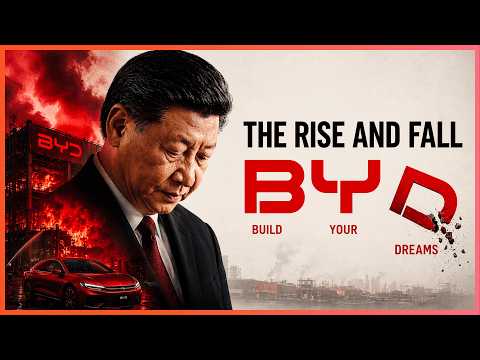
BYD, once a small battery maker, has rapidly become the world's largest electric vehicle seller, disrupting traditional car giants through vertical integration, innovative battery technology, and strategic government support. However, hidden financial risks and quality issues raise questions about its sustainability. This story reflects China's broader industrial ambitions reshaping global markets.
For about a century, the global car industry was dominated by three countries: Germany, Japan, and the United States. From these nations emerged iconic brands such as Toyota, Volkswagen, Mercedes, Ford, Honda, and BMW. These companies were not just manufacturers; they were symbols of national pride and economic pillars.
In just three years, this dominance has been challenged dramatically. Mercedes experienced a 28% profit collapse, Porsche lost 92% of its bottom line in a single year, and Stellantis, the group behind Jeep, Honda, and Fiat, posted a $26 billion loss—the worst in its history. Volkswagen announced 15,000 job cuts. Behind these blows, one name repeatedly appears: BYD.
Until 2003, BYD was merely a small battery producer. The idea that it could compete with Tesla was once so absurd that Elon Musk laughed at the notion on live American television. Today, BYD sells more electric cars than anyone else on the planet.
BYD's rise is not just a story of a Chinese brand winning domestically. It is a global phenomenon. BYD and other Chinese automakers are dominating markets across continents, including Southeast Asia, Europe, Brazil, Mexico, Israel, and Norway.
The United States remains the only major market where BYD is officially blocked for national security reasons, but even there, the situation is seen as a temporary holding pattern.
Wong Chuan Fu, an engineer who started BYD in 1995 with a $40,000 loan, initially focused on rechargeable batteries. By 2003, BYD was the world's largest battery maker. That year, Wong bought a bankrupt state-owned car factory, a move met with skepticism and stock price drops.
His logic was simple: the future of cars was the battery, not the engine. While others tried to electrify cars, Wong aimed to build cars around batteries he mastered.
Vertical Integration: BYD decided to build everything in-house—batteries, semiconductors, motors, electronics, glass, software—unlike competitors who relied on external suppliers. This allowed BYD to weather global chip shortages and lithium price spikes better than others.
Hybrid Strategy: While Tesla and others focused on pure electric vehicles, BYD invested heavily in plug-in hybrids (PHEVs), which run on electricity for daily commutes and gasoline for longer trips. This strategy made sense in China, where charging infrastructure outside big cities was limited, giving BYD access to 500 million consumers.
Blade Battery Innovation: In 2020, BYD introduced the blade battery using lithium iron phosphate chemistry, which is cheaper, safer, and longer-lasting than the nickel-cobalt batteries used by others. This allowed BYD to offer lower-priced cars with a genuine safety advantage. Tesla even started buying batteries from BYD.
Despite these innovations, BYD's success is also deeply tied to Chinese state support. Between 2015 and 2020, BYD received approximately $4.3 billion in direct subsidies from the Chinese government. In 2016, subsidies exceeded the company's net profit.
Support came in many forms:
This state backing allowed BYD to sell below cost for years while remaining profitable, creating an uneven playing field for competitors like Volkswagen and Toyota.
A 2025 report by GMT Research revealed that BYD's real debt might be nearly eight times higher than officially reported, hidden in supply chain financing where BYD delays payments to suppliers for an average of 275 days, far exceeding industry norms.
BYD dealerships reportedly register thousands of new cars under shell companies at month-end to meet sales targets, then resell them as "used 0 km" vehicles. Many of these cars remain unsold, parked in lots and rusting, raising doubts about the authenticity of BYD's reported sales figures.
BYD's net profit dropped 19% in 2025, and global sales fell 41% year-over-year in early 2026. Rival Chinese automaker Gile is gaining ground domestically. The Chinese government has publicly warned carmakers that the ongoing price war is unsustainable.
BYD is a key instrument in China's "Made in China 2025" plan, which aims to dominate ten strategic industries globally, including automotive. The aggressive subsidies and support were part of a deliberate strategy to build a global supply chain and lock in market dominance.
As Western governments react with tariffs and investigations, China has already begun winding down subsidies, having achieved its objectives. The global automotive landscape has been reshaped, and the implications extend beyond cars.
BYD's story is not just about a company building better cars; it's about a systemic shift in global industrial power. Whether BYD collapses under hidden debts or becomes the Toyota of the 21st century, the rise of Chinese industry is undeniable.
Businesses worldwide must recognize that the rules have changed. The leaders in innovation and market disruption are now in Chinese cities like Shenzhen and Hangzhou, not Detroit or Stuttgart.
This transformation is unfolding across multiple industries, and understanding it is crucial for anyone engaged in global business today.
If you observe similar shifts in your industry, it is worth paying close attention to the evolving dynamics shaped by China's strategic ambitions.
This comprehensive look at BYD reveals the complexities behind its meteoric rise and the challenges it faces, offering insights into the future of the global automotive industry and beyond.