
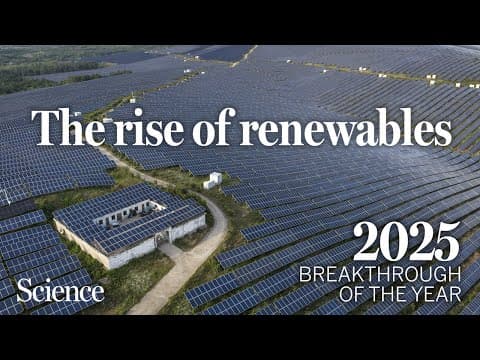
In 2025, renewable energy surpassed coal in electricity generation worldwide, marking a tipping point in the fight against climate change. Driven by technological advances, economic factors, and policy goals like the Paris Agreement, renewables such as solar and wind are expanding rapidly, especially in China and the global South. Despite challenges like infrastructure needs and geopolitical tensions, renewables are poised to continue growing and help flatten global emissions.
When you drive your car or turn up the thermostat on your natural gas furnace, you are using ancient solar energy that fell on the world tens, hundreds of millions of years ago. Now, the world is shifting to current solar energy — the energy that streams from the sun every day. Renewables are not just the virtuous thing to do; they can also be the profitable thing to do.
Every year, science editors select what they consider the biggest breakthrough in the world of science. Sometimes it is a major research advance, but other times it is something in the world of science that will have significant consequences for society. In 2025, the chosen breakthrough was the tipping point for renewable energy.
In 2025, renewables crossed two key thresholds:
While fossil fuel use is still rising and solar and wind remain only a fraction of the world’s total energy use, these milestones suggest that renewable energy is gaining unstoppable momentum.
The Paris Climate Agreement set ambitious goals to keep global warming below 2 degrees Celsius, preferably as low as 1.5 degrees Celsius. Achieving these goals requires emissions to peak quickly and then decline sharply, which means a massive expansion of renewable energy.
Currently, the world is far from on track to meet these goals. However, some regions have already peaked in emissions:
This flattening is largely due to the tremendous growth in renewable energy.
China’s emissions peak will significantly contribute to a global emissions peak. This story traces back more than two decades when China faced an energy security challenge and severe air pollution, prompting a pivot away from coal-fired power plants.
Chinese decision-makers pursued clean technology sectors, starting with wind and then solar energy. Today:
The massive domestic market helped manufacturers scale up and reduce production costs, making China more efficient and cheaper in producing renewable technologies compared to other countries like the US. Increasingly, China exports solar panels and solar products worldwide.
Solar energy is booming throughout the global South, with very few countries where it isn’t taking off. A major driver is energy security:
What was once a feature of wealthy countries driven by climate policies and subsidies has become a grassroots movement in the global South, where solar energy is practical and cheap.
One challenge for many Western countries is their reluctance to fully utilize cost-competitive clean tech products from China, largely due to political and geopolitical reasons.
Decarbonizing the economy while decoupling from China’s dominant role in renewable technology production is a significant challenge. From a US perspective, it seems unlikely given China’s leading position.
Expanding renewables enough to drive emissions down requires building extensive infrastructure:
To address this, China is building battery farms for energy storage and high-voltage transmission lines to transport electricity over long distances. However, even this infrastructure is barely keeping up with demand.
Building similar infrastructure will be much harder for other countries, posing a stumbling block to rapid renewable energy expansion.
Experts are confident that renewable energy growth will continue. Although the exponential growth seen in recent years may slow somewhat, the economic and practical reasons for using wind and solar energy remain strong and unlikely to disappear.
The critical question is whether this growth will be fast enough to avoid the worst consequences of climate change.
The year 2025 marks a pivotal moment in the global energy transition, with renewable energy surpassing coal in electricity generation and expanding rapidly worldwide. China’s leadership and the solar boom in the global South are key drivers of this shift. Despite challenges such as infrastructure needs and geopolitical tensions, renewables are on a roll, offering hope for flattening global emissions and mitigating climate change impacts. The coming years will be crucial in determining how quickly the world can capitalize on this momentum to secure a sustainable energy future.



















