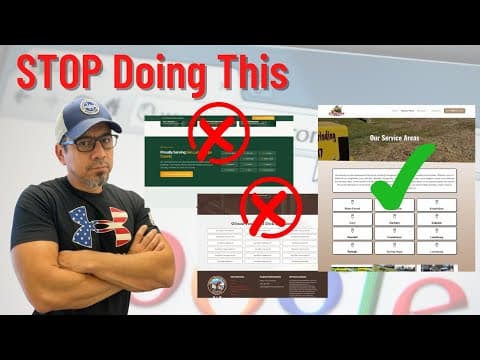
Contractors and home service businesses often serve multiple locations and create location-specific pages. This article explains why linking these location pages directly from the homepage dilutes SEO value and how to properly structure your website using a service area hub page to optimize search engine rankings and maintain focus on your main service and location.
If you are a contractor or a home service business owner, you likely serve clients across multiple cities or regions rather than just one central location. Whether you are a plumber, roofer, carpet cleaner, or junk removal service, your service area probably spans 10, 20, or even 30 miles or more. To capture local search traffic, many businesses create individual location pages or service area pages for each city or town they serve.
But how should you organize these location pages on your website? Should they be linked from your homepage menu, footer, or somewhere else? This article shares insights on the best way to structure your service location pages to maximize SEO benefits and avoid diluting your website’s authority.
Imagine your website homepage as a hamburger:
Google’s crawlers pay the most attention to the links and content within the "meat" or main content area of your pages. Links placed only in the header or footer are seen but generally carry less SEO weight or authority.
This means that while you can place many links in your menu or footer, Google does not give those links as much relevance or authority compared to links embedded in the main content.
If you create multiple location pages and link them all directly from the main content area of your homepage, you risk diluting the SEO power of that page. For example, if you have a page focused on "Stump Grinding in Raleigh, North Carolina," linking out to many other location pages within the main content can confuse Google about the primary focus of that page.
Instead, the homepage or service page should maintain a clear, focused theme — such as a specific service in a specific location — and only link to related sub-services that support that main topic.
For instance, a paving contractor’s homepage for San Jose should only link to other paving-related services in San Jose, not to other locations or unrelated services.
The best practice is to create a dedicated service area hub page that lists all the locations you serve. This hub page acts as a central directory for your location-specific pages.
This structure keeps your homepage focused and authoritative for your main service and location, while still allowing you to target multiple locations through the hub page.
Each location page should focus solely on the service offered in that specific location and link only to related sub-services within that location.
For contractors and home service businesses looking to improve their local SEO, structuring your website with a clear hierarchy is essential. Use your homepage to focus on your main service and location, create a service area hub page to list all your locations, and link to individual location pages from there.
This approach prevents dilution of link authority, helps Google understand your site’s structure better, and ultimately improves your chances of ranking higher in local search results.
If you want to learn more about building and optimizing your website for SEO, including content creation and interlinking strategies, consider exploring specialized training or consulting services tailored for local businesses and contractors. Effective SEO combined with a well-structured website and Google Business Profile can significantly increase your leads and visibility.
By following these guidelines, you can ensure your website is optimized for both users and search engines, helping your business grow in multiple service areas without sacrificing SEO effectiveness.