
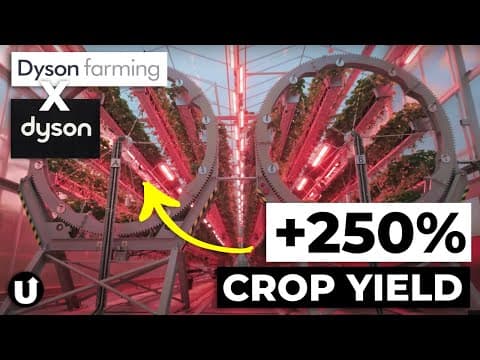
Dyson Farms in the UK is pioneering automated vertical farming with a focus on sustainability and efficiency. Their unique approach combines advanced technology with traditional farming practices, resulting in higher yields and lower environmental impact. This blog explores Dyson's innovative methods, the challenges faced by vertical farming, and the potential for a sustainable future in agriculture.
In the realm of agriculture, vertical farming has emerged as a promising solution to address food security and sustainability challenges. However, many ventures in this field have faced significant hurdles. Dyson Farms, located in Carrington, UK, is making waves with its state-of-the-art automated vertical farming facility, which boasts over a million strawberry plants grown on innovative rotating rigs. This blog post delves into Dyson's unique approach, the challenges of vertical farming, and the potential for a sustainable agricultural future.
Dyson Farms operates a cutting-edge facility where strawberry plants are cultivated on 24-meter long, 5.5-meter tall rotating rigs. This design allows each plant to receive ample sunlight, minimizing the need for artificial lighting. The facility is largely automated, featuring robots for strawberry picking, UV systems to combat mold, and even robots that introduce beneficial insects to control pests.
Dyson claims that their innovative farming methods enable them to produce 2.5 times the yield of a conventional greenhouse, amounting to 1,250 tons of strawberries annually. This remarkable output raises questions about the viability of vertical farming, especially in light of recent industry failures.
Despite the promise of vertical farming, many startups have struggled to achieve financial sustainability. High-profile failures have led to skepticism about the economic sense of vertical farming. Key challenges include:
Vertical farming has experienced a classic hype cycle, characterized by inflated expectations followed by disillusionment. However, Dyson's approach appears to be moving towards practical adoption, distinguishing itself from other failed ventures.
Dyson Farms operates in a hybrid space between traditional greenhouses and fully indoor farms. This model leverages the benefits of natural sunlight while incorporating advanced technology. Key features include:
Dyson's farming practices aim to minimize carbon emissions. By utilizing biogas for energy and capturing waste heat and carbon dioxide, the facility creates an optimal growing environment without additional inputs. This approach aligns with the principles of regenerative agriculture, focusing on improving soil health and biodiversity.
Beyond vertical farming, Dyson is also integrating technology into traditional farming practices. Innovations include:
Dyson Farms exemplifies how innovative thinking and technology can transform agriculture. By combining sustainable practices with cutting-edge technology, Dyson is not only increasing food production but also addressing environmental concerns. Their iterative, evidence-led approach contrasts sharply with the rapid scaling seen in many failed vertical farming startups. As Dyson continues to refine its methods, it may pave the way for a more sustainable and economically viable future in agriculture.
As the world grapples with food security and environmental challenges, Dyson's farming innovations could serve as a model for the industry, demonstrating that imagination and systems thinking can lead to a better future for food production.



















