Since 2023, Germany has faced an economic crisis marked by negative growth, largely due to its decision to phase out nuclear power without adequate renewable alternatives, reliance on Russian gas, and infrastructure delays. These choices have led to soaring energy prices, industrial decline, and demographic challenges, threatening Germany's status as an industrial powerhouse.
Since 2023, Germany has been experiencing an economic crisis characterized by negative growth, while other major advanced economies continue to expand. This downturn is largely the result of a series of decisions regarding energy policy that have had profound and unintended consequences. This article explores how Germany's choices, particularly the phase-out of nuclear power and reliance on Russian gas, have contributed to its current economic challenges and what this means for its industrial future.
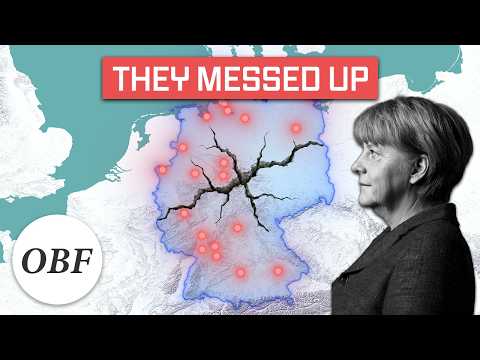
Germany once operated numerous nuclear power plants, each represented by a light on the map of the country. Over the span of just 20 years, every single nuclear plant has been shut down. This was a deliberate decision made by the German government, which has become a major catalyst for the country's economic difficulties and de-industrialization.
In 2002, the Social Democrats under Gerhard Schröder formed a coalition government with the Greens, known as the Red-Green Coalition. The Greens had long opposed nuclear power, and this coalition marked their opportunity to implement change. They agreed on a plan to shut down all nuclear power plants by 2022, a 20-year timeline intended to allow utilities and the power grid to adapt and build alternatives.
The assumption was that by 2022, renewable energy technologies would be advanced and affordable enough to replace nuclear power easily. However, this assumption did not hold true.
Recognizing that renewables were not ready by 2022, Angela Merkel's government extended the life of nuclear plants by 12 years. Despite growth in solar and wind energy, these sources could not reliably provide base load power 24/7, and battery storage technology was insufficient at the time.
However, the Fukushima nuclear disaster in Japan in 2011 dramatically shifted public opinion in Germany. Despite Germany's lack of tsunami risk and stable continental geology, public panic and political pressure led to the immediate shutdown of eight reactors and a commitment to close the remaining nine by 2022. This decision prioritized ideology and politics over scientific and geographic realities.
With nuclear power plants shutting down and renewables not yet capable of filling the gap, Germany became heavily reliant on Russian natural gas imports. By 2021, Russia supplied 55% of Germany's natural gas, which was considered a "bridge technology" to renewables. This reliance proved to be a critical vulnerability.
In February 2022, Russia invaded Ukraine, and by summer, began throttling gas supplies to Germany. The sabotage of the Nord Stream pipelines in September 2022 severed the physical connection, causing energy prices to spike dramatically.
By late 2024, electricity prices in Germany reached €820 per megawatt-hour, compared to €100-€150 in France, which still operates its nuclear fleet. This price was not a peak paid by a few but the wholesale price paid by all consumers.
Electricity prices in Europe are set by the most expensive power plant needed to meet demand at any moment, similar to an auction where the last bid sets the price for everyone.
Had Germany retained its nuclear power plants, which provide constant, low-cost base load power, it would have reduced reliance on expensive gas plants and kept prices lower.
Interestingly, Germany now relies heavily on electricity imports from neighboring France and Switzerland, both of which operate nuclear power plants close to the German border. Despite Germany's opposition to nuclear power domestically, it purchases mostly nuclear-generated electricity from these neighbors to avoid total energy collapse.
This paradox highlights the contradictions in Germany's energy policy.
Germany's renewable energy strategy also faces significant challenges. Most wind turbines are located in the North, where wind is consistent, but most industrial plants are in the South.
The solution—a transmission line called the SuedLink—has been delayed due to opposition from Bavaria, which demanded the line be buried underground. This decision increases costs by four to ten times and delays completion by six years, pushing the project to 2028.
As a result, Germany must pay wind farms in the North to shut down when the grid cannot handle excess power and pay gas and coal plants in the South to meet demand, costing billions annually.
High energy prices have made German industry uncompetitive globally. In 2024, industrial electricity prices in Germany are approximately €0.199 per kilowatt-hour, compared to €0.075 in the United States and €0.082 in China.
This disparity means industries such as chemical plants and steel mills face significantly higher costs, leading companies like BASF, one of Germany's largest chemical firms, to invest $10 billion in China and move production abroad.
Germany's traditional model of exporting machinery and cars to China and the world is under threat, as the country now runs a trade deficit with China of €66.3 billion, importing batteries, solar panels, and electronics instead.
Adding to the economic woes, Germany faces a rapidly aging population. The baby boomer generation is retiring, and the workforce is shrinking by an estimated 7 million people by 2035.
This demographic shift has significant fiscal implications:
Germany's energy and economic challenges stem from a series of interconnected decisions:
These choices prioritized ideology and politics over scientific and economic pragmatism, resulting in significant economic consequences.
The critical question remains whether Germany can reverse course and address these challenges before the situation worsens.
This comprehensive overview highlights the complexity and gravity of Germany's economic and energy crisis, emphasizing the importance of balanced and pragmatic policy decisions in securing a nation's industrial and economic future.