
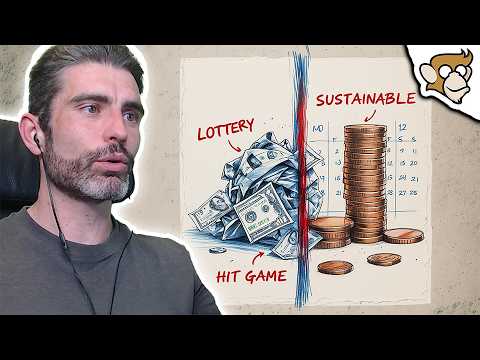
Making a living as an indie game developer without a blockbuster hit is challenging but achievable through sustainable strategies. This article explores the realities of indie game revenue, shares personal experiences, and discusses practical approaches such as contract work, focusing on niche genres, asset development, and managing living costs to build a long-term career in indie game development.
Many aspiring indie game developers dream of creating the next big hit like Stardew Valley, Minecraft, or Hollow Knight—games that generate hundreds of millions of dollars. However, relying on such a hit is akin to hoping to win the lottery and is not a viable long-term plan for most developers. Instead, focusing on building a sustainable indie game development business is a more realistic and achievable goal.
The indie game market is tough. Statistics show that over half of indie games make less than $1,000 in revenue, and a significant portion of those make less than $100. Only a small percentage of games earn over $10,000. For developers who spend around six months creating a game, making at least $50,000 per game is often necessary to sustain a living.
This means roughly 10% of indie games find financial success, while 90% do not. Success here is defined in terms of making a living from game development as a primary job, where money is a critical factor.
The author began making games in 2013 and managed to make a living solely from indie game development for several years before starting to earn from a YouTube channel in 2020. Over this period, more than 40 games were developed, spanning various genres and platforms.
While some games performed well—such as one with 1,700 reviews and approximately $250,000 in revenue—others were significant flops. Despite this, the overall average revenue allowed for a sustainable business. This experience highlights that consistent effort and managing a portfolio of games can lead to long-term sustainability without a single massive hit.
One practical approach to sustainability is contract work or freelancing. This provides a guaranteed income stream by working for clients, which can help cover living expenses while developing personal game projects during off-hours. Although finding clients can be challenging, contract work offers financial stability and reduces the risk of financial hardship.
Another strategy is to identify and focus on a niche genre with a dedicated but underserved audience. For example, Stardew Valley succeeded partly because it filled a gap left by the decline of Harvest Moon games. By creating one quality game per year in a specific niche, developers can build a loyal audience and improve their skills through repeated work in the same genre.
Jeff Vogel of Spiderweb Software exemplifies this approach, having developed niche RPGs for over 20 years. His efficiency and dedicated audience allow him to sustain his business without mainstream hits.
Indie development is not limited to making games. Creating and selling assets or tools for other developers is a viable career path. Asset stores are large markets where developers can sell visual assets, tools, and other resources. Companies like Cindy Studios have built multi-million dollar businesses by focusing solely on asset creation.
A crucial factor in sustainability is controlling personal expenses. Lower living costs reduce the revenue needed from games to break even or profit. For instance, living in Portugal allows the author to maintain a good lifestyle on about $2,000 per month, meaning a game developed over six months only needs to generate around $12,000 to be profitable.
In contrast, living in expensive cities like San Francisco could require $10,000 per month, making it much harder to sustain indie development without hits. Developers should consider their cost of living carefully and explore ways to reduce expenses to improve their chances of sustainability.
Making a living as an indie developer without a blockbuster hit is difficult but possible. By adopting sustainable strategies such as contract work, focusing on niche genres, creating assets, and managing living costs, developers can build a viable career. Persistence, skill development, and smart financial management are key to long-term success in indie game development.
Aspiring indie developers should focus on sustainability rather than chasing rare hits, enabling them to continue creating games and enjoying their craft for many years to come.



















