
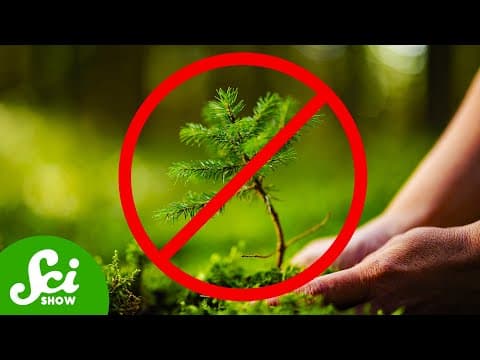
While planting trees is often seen as a solution to climate change, researchers suggest that selectively killing and burying some trees may be a more effective method for long-term carbon storage. This approach could help balance the carbon cycle and mitigate the effects of climate change more efficiently than traditional tree planting.
Trees are often celebrated for their beauty, their ability to provide food, and their crucial role in the carbon cycle. They absorb carbon dioxide and release oxygen, making them essential in the fight against climate change. However, recent research suggests that to effectively combat climate change, we may need to consider a more controversial approach: killing some trees.
Carbon is a fundamental element found in all living organisms and many non-living things. It exists in various forms throughout the environment, including the atmosphere, oceans, and soil. Carbon dioxide (CO2) is a greenhouse gas that plays a significant role in regulating the Earth's temperature by trapping heat. While greenhouse gases are necessary for maintaining a habitable climate, human activities, particularly the burning of fossil fuels, have disrupted the natural balance of the carbon cycle.
As a result, we are releasing more CO2 into the atmosphere than the carbon cycle can manage, leading to global warming and ocean acidification. To address this imbalance, scientists are exploring methods of carbon dioxide removal (CDR).
Planting trees is often viewed as a straightforward solution to climate change. However, it is not as simple as just digging a hole and planting a seed. Ecosystems are complex, and the effectiveness of tree planting varies depending on the environment. For instance, carbon storage differs significantly between forests, grasslands, and savannas. Planting trees in unsuitable areas can disrupt existing ecosystems and may not yield the desired carbon absorption.
Moreover, trees have limitations in their carbon storage capabilities. They absorb CO2 while growing, but they also release it through respiration and when they decompose or burn. This means that even if we plant millions of trees, their ability to sequester carbon is finite and temporary compared to the long-term storage potential of fossil fuels.
In a groundbreaking study published in September 2024, researchers discovered a potential solution to the short-term nature of carbon storage in trees. While digging a trench in Quebec, Canada, they unearthed a 3,775-year-old Eastern red cedar log buried two meters underground. This finding led to the concept of a "wood vault," where trees could be buried in oxygen-poor environments to prevent decomposition.
The researchers found that the ancient buried tree had lost only about 5% of its carbon over thousands of years, suggesting that burying trees could effectively store carbon for extended periods. They propose that cutting down some living trees and burying them in suitable conditions could be a viable method for long-term carbon storage.
The researchers estimate that an optimized wood vaulting system could sequester around 10 billion tons of CO2 annually at a cost of $30 to $100 per ton. This price is significantly lower than many high-tech carbon storage solutions, making it an attractive option for addressing climate change.
While the idea of killing trees may seem counterintuitive, the research suggests that strategically burying some trees could provide a more effective and economical solution for long-term carbon storage. This approach could help restore balance to the carbon cycle and mitigate the impacts of climate change. As we continue to explore innovative solutions, it is essential to recognize the value of both living and buried trees in our efforts to protect the planet.



















