
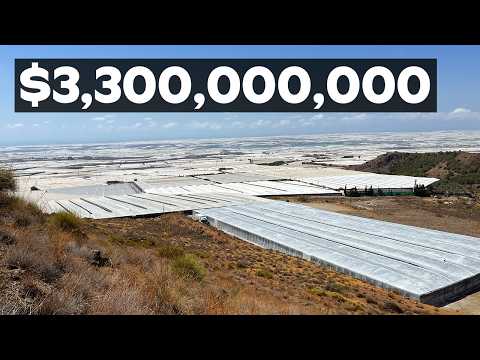
Spain's Almería province hosts one of the world's largest greenhouse complexes, known as the Plastic Sea, covering 370 square kilometers. These greenhouses use innovative techniques to maximize productivity and water efficiency in a dry region, making farming highly intensive and profitable. This transformation has significant economic and environmental implications, showcasing the future of sustainable agriculture.
In the Sierra de Gádor mountains of Spain's Almería province lies a remarkable agricultural phenomenon known as the Plastic Sea. Stretching about 40 kilometers, this vast expanse of greenhouses covers approximately 370 square kilometers—an area slightly larger than the island nation of Malta. From a satellite view, the region appears strikingly white due to the reflective plastic sheets covering the greenhouses, making it visible from space. NASA even estimates that this reflective surface cools the region, contrasting with the warming trend in the rest of southern Spain.
This area hosts one of the world's largest concentrations of greenhouses, with around 14,000 growers and up to 300,000 tons of plastic used to cover the farms. But why has this region become a hub for such intensive greenhouse farming, and what lessons does it offer for the future of agriculture?
To understand the success of this region, a visit to the Cajamar Experimental Station provides valuable insights. This research facility tests new agricultural techniques and evaluates their profitability.
Greenhouses in Almería are approximately 30 times more productive per acre than average European farms. This intensive farming approach relies on maximizing yields through controlled environments.
Most greenhouses here use a wireframe mesh covered with polyethylene plastic sheets on both sides, creating an insulating air bubble. This design allows sunlight to penetrate and concentrate solar energy inside, accelerating photosynthesis compared to open fields where sunlight can be lost.
Some advanced greenhouses also control humidity and CO2 levels to optimize plant growth further.
While glass greenhouses offer durability and cleanliness, they are significantly more expensive and require external heating, usually from natural gas, increasing operational costs. Plastic greenhouses, though less durable, are more cost-effective and suitable for the region's climate.
Mulching is used to retain soil moisture and heat, with materials like plastic, sand, and experimental use of straw. Fertilization is managed through computerized systems that dissolve and distribute nutrients efficiently.
Biological pest control is employed using bank plants that attract beneficial insects which prey on pests, reducing the need for chemical fertilizers and pesticides. These plants are strategically placed between greenhouses and around crops to slow pest spread.
Water-saving innovations are critical in this dry region. Features include:
Almería is one of Europe's driest regions, with less than 200 millimeters of annual rainfall—half that of Madrid, a city known for its dry climate. Despite this, the area supports extensive farming due to two main factors:
The intensive greenhouse farming model has transformed Almería's economy, creating thousands of jobs and making the region a significant exporter of fruits and vegetables. However, challenges remain, including the environmental impact of plastic waste, fuel consumption, and labor issues.
Almería's Plastic Sea exemplifies how innovative agricultural practices can overcome environmental constraints to boost productivity and economic growth. The region's use of greenhouses demonstrates the potential for intensive, water-efficient farming in arid areas, offering a blueprint for sustainable agriculture worldwide. However, balancing economic benefits with environmental sustainability remains a critical challenge moving forward.



















