
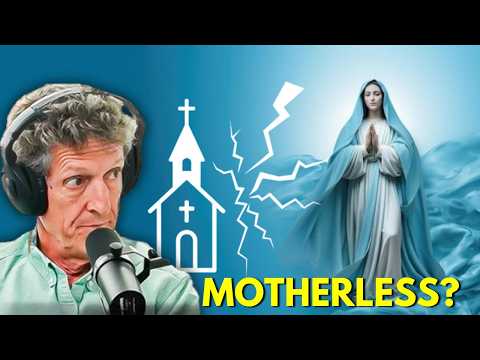
The doctrine of Mary's sinlessness reveals significant fractures in Protestant theology, particularly regarding grace and salvation. This article explores how this belief challenges key Protestant principles like sola fide and sola scriptura, and presents biblical and historical evidence supporting Mary's unique holiness. It also clarifies the concept of the immaculate conception and its implications for understanding grace and transformation in the Christian life.
Most people perceive Marian doctrine as merely Catholic overreach—too emotional, too speculative, and too extra-biblical. However, the doctrine of Mary's sinlessness does not only challenge Protestant views of Mary; it unveils a deeper fracture within Protestant theology itself. This fracture impacts the understanding of grace, salvation, and even Jesus Christ. In this article, we will explore how the doctrine of Mary's sinlessness disrupts the Protestant framework from four distinct angles.
The first challenge posed by Mary's sinlessness is to the Protestant doctrine of sola fide, or justification by faith alone. This doctrine is a cornerstone of much of Protestant theology, asserting that humans are declared righteous by God not due to any internal transformation but because of Christ's righteousness being legally credited to them. In this view, a person remains, as Martin Luther famously stated, "simul justus et peccator"—at once righteous and a sinner.
However, Mary does not fit this model. If she was sinless from the beginning, she did not require forgiveness in the conventional sense. Instead, she was genuinely righteous and holy by God's grace. Furthermore, the grace she received was prior to the passion and resurrection of Christ. According to Catholic teaching, defined in Ineffabilis Deus by Pope Pius IX in 1854, Mary was preserved from original sin from the very moment of her conception, in view of the merits of Jesus Christ. This concept represents not a post-cross salvation applied backward but a preventative salvation enacted by a God who exists outside of time.
Thus, the Protestant framework faces a dilemma: either deny Mary's sinlessness despite Luke 1:28 calling her "full of grace," or acknowledge that justification can involve a real internal sanctification that prevents sin from taking root—an idea that aligns more closely with Catholic theology than Protestant.
The second challenge Mary's sinlessness presents is to the principle of sola scriptura. Many Protestants argue that the sinlessness of Mary cannot be true because it is not explicitly stated in scripture. However, this argument reveals an inconsistency: the canon of scripture itself is not explicitly outlined in the Bible. There is no divinely inspired table of contents that emerged from the tradition of the church. Why, then, apply one standard of proof to Mary while applying another to the Bible?
Moreover, the assertion that Mary's sinlessness is false because it lacks explicit mention in scripture misunderstands how biblical typology and doctrinal development function. The early church did not merely seek proof texts; they read scripture as a cohesive whole, recognizing types, shadows, and fulfillments, and relied on the spirit-guided teaching of the church for proper interpretation. Protestants often emphasize being biblical, yet when it comes to doctrines that highlight Mary's role, such as her sinlessness or her being the Ark of the New Covenant, the interpretive method shifts dramatically. Instead of recognizing continuity, they demand chapter and verse as if in a courtroom.
When examining scripture and the writings of early church fathers, it becomes evident that the doctrine of Mary's sinlessness is not a modern invention but has ancient roots.
In Luke 1:28, the angel Gabriel greets Mary as "full of grace"—a unique title not used elsewhere in scripture. The verb tense implies a completed and ongoing state of grace, indicating that this is not merely a polite greeting but an identity. Additionally, in Genesis 3:15, God declares, "I will put enmity between you and the woman and between your seed and her seed." This woman is not just Eve; it ultimately refers to Mary, whose seed, Jesus Christ, crushes the serpent's head. If Mary has total enmity with the serpent, it implies that there is no sin in her, as sin would signify a form of alliance, however small.
In Romans 5:12-19, Paul contrasts Adam and Christ, fall and redemption, but Mary fits into this narrative as well. Just as Eve cooperated in disobedience, Mary cooperated in obedience, earning her the title of the new Eve among early church fathers. St. Ephraim the Syrian, in the 4th century, wrote, "You and your mother are the only ones who are completely beautiful in every way. For in you, Lord, there is no stain, and in your mother, no stain." St. Augustine, often cited by Protestants, acknowledged in Nature and Grace that he wished to raise no question regarding the holy virgin Mary when discussing sins, out of honor to the Lord.
The Catechism of the Catholic Church (CCC) summarizes this teaching clearly. CCC 491 states that through the centuries, the church has become increasingly aware that Mary, full of grace through God, was redeemed from the moment of her conception. CCC 492 emphasizes that the unique holiness she possesses comes entirely from Christ. Even Hebrews 7:26, while referring to Christ, describes a savior who is holy, blameless, unstained, and separated from sinners. The church believes that grace can achieve this not only for Christ but also for Mary, through His power.
The doctrine known as the Immaculate Conception explains how the church reconciles these teachings. It does not imply that Mary saved herself or that she did not need Christ; rather, it emphasizes that she needed Him more than anyone else. Unlike humanity, which is pulled from the mud after falling into sin, Mary was never allowed to fall into sin. She was saved in a more perfect way—preventatively—due to her unique role in bearing the Savior. Pope Pius IX declared this in Ineffabilis Deus, but the roots of this belief are ancient, connecting Mary with Genesis 3:15 as the woman in enmity with the serpent.
Understanding that Christ's grace is powerful enough to preserve one person entirely from sin suggests that it can also transform others. While this does not mean achieving sinlessness, it does imply a genuine interior change towards holiness. Many resist this teaching, believing that sanctity is unattainable. However, Mary serves as proof that it is not. She is not an exception to the rule but rather the first full result of grace's transformative power.
Several objections often arise regarding the doctrine of Mary's sinlessness:
In conclusion, the doctrine of Mary's sinlessness reveals significant weaknesses in Protestant understandings of grace and scripture. It is supported by both scripture and tradition when read in conjunction. Furthermore, the Immaculate Conception magnifies Christ's saving power rather than competing with it.
To deepen your understanding, consider reading Luke 1:28 and Genesis 3:15 together. Meditate on how God's plan for salvation began not with the cross but with a woman. Ask Mary to help you trust in grace more profoundly—not just for forgiveness but for transformation. If this exploration has been helpful, consider sharing it with a friend and subscribing for more insights into Catholic teachings. Remember, grace is not merely a pardon; it is a transformative power, as exemplified by Mary.



















