
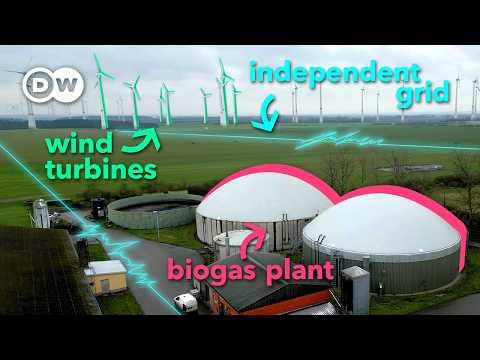
Feldheim, a small village near Berlin, transformed into a fully renewable energy community with its own independent power grid, resulting in significantly lower electricity prices for residents. This success was driven by early wind turbine adoption, community involvement, a biogas plant, solar power, and a local heating network, showcasing a unique model of sustainable energy transition in rural Germany.
In recent years, rural Germany has often been portrayed as resistant to clean energy initiatives, with even the Chancellor criticizing wind turbines for their appearance and impact on the landscape. Many people seem to support renewable energy in principle but oppose it in their own backyards. However, the village of Feldheim, located just outside Berlin, presents a strikingly different story. Feldheim has embraced renewable energy fully, operating its own independent power grid and enjoying some of the cheapest energy prices in the country.
At first glance, Feldheim appears to be a typical rural village surrounded by vast fields. The name "Feldheim" fittingly reflects its windy environment, which has been a key factor in its renewable energy success.
Michael Raschemann, an engineering student about 30 years ago, initiated the village's green energy journey by installing four wind turbines. Over time, this small project expanded into a large wind farm. Alongside wind power, Feldheim also utilizes a biogas plant that converts organic waste into clean electricity and heating, a wood-fired heating system for colder days, a solar plant, and a large battery storage system.
Together, these infrastructures generate hundreds of millions of kilowatt-hours of electricity annually, far exceeding the needs of Feldheim's small population. Remarkably, less than 1% of the renewable energy produced is consumed locally. The wind farm's power is delivered directly to residents through an independent grid, resulting in very low electricity costs.
Residents of Feldheim pay only 12 cents per kilowatt-hour for electricity, which is about one-third of the price paid by consumers in Berlin. For example, a monthly electricity bill of 50 euros in Berlin would cost only 15 euros in Feldheim when all fees are considered. This affordability has made the local population strong supporters of the wind farm and other renewable energy projects in their community.
Back in the 1990s, when Michael Raschemann first proposed building wind turbines, Feldheim was a rural area in former East Germany facing economic challenges after reunification. Many industries had shut down, and people had to commute long distances for work. Raschemann's idea was initially met with curiosity and skepticism.
However, he engaged in extensive dialogue with the local government, residents, and the farmers' cooperative that managed much of the land. Together, they decided on turbine locations that would minimize disturbance, such as placing turbines far enough from houses to avoid casting shadows. This phase of open communication and community involvement was crucial in gaining acceptance.
As Raschemann and his wife founded the company EnergieQuelle to expand the wind farm, they continued to keep the community informed and involved, fostering a sense of ownership and trust.
Sebastian Herbst, head of the agricultural cooperative, explains that farmers faced unstable incomes in the early 2000s due to lowered EU minimum prices and high oil costs for heating livestock facilities. To diversify income and reduce costs, the cooperative partnered with EnergieQuelle to build a biogas plant.
This plant uses manure, crushed grain, and corn to produce biogas, capturing methane that would otherwise escape into the atmosphere and converting it into electricity and heating. This initiative not only provided a more climate-friendly fuel but also secured jobs and created new employment opportunities in the community.
Initially, all renewable energy produced in Feldheim was fed into the public grid, and residents had to buy it back from power suppliers, incurring grid fees and surcharges. EnergieQuelle attempted to purchase the local section of the power grid to avoid these charges but was unsuccessful.
In response, EnergieQuelle collaborated with the local government to build an independent electricity grid in 2010, including their own power lines. The community also wanted renewable heating access, leading to the creation of a local heating network supported by households, businesses, farms, and funding from the state and the EU. Each household invested approximately 3,000 euros into this energy transition.
This move made Feldheim unique in Germany, attracting visitors worldwide interested in its innovative approach.
Today, there are over 180 bioenergy villages across Germany, many of which rely heavily on biomass for power and heating. However, Feldheim stands out because it operates completely off-grid with its own heating and electricity networks.
Despite its success, Feldheim's model cannot be easily replicated everywhere. Its small size, tightly knit and curious community, short distances between power sources and homes, and the influential farmers' cooperative all contributed to its success. Similar microgrid models exist in places like the Isle of Eigg in Scotland and Kodiak Island in Alaska, but larger towns or communities without these natural advantages would face greater challenges.
Feldheim's journey from a struggling rural village to a renewable energy pioneer demonstrates the power of community engagement, diversified clean energy sources, and local control over energy infrastructure. By building trust, involving residents, and investing in their own grid and heating networks, Feldheim residents enjoy affordable, clean energy and serve as an inspiring example for other communities worldwide.
Could a similar approach work in your community? The success of Feldheim shows that with the right conditions and cooperation, renewable energy can be both sustainable and economically beneficial.



















