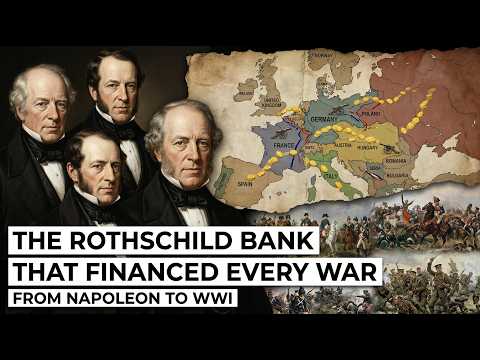
The Rothschild banking family played a pivotal role in financing major European conflicts from the Napoleonic Wars through World War I. Originating from a Jewish ghetto in Frankfurt, they established a multinational banking network that provided crucial war loans, managed sovereign debts, and influenced global finance. Their legacy reveals the profound connection between capital and power in modern history.
A famous quote attributed to Nathan Rothschild, the most formidable banker of the 19th century, states: "I care not what puppet is placed upon the throne of England. The man who controls Britain's money supply controls the British Empire, and I control the British money supply." While the exact wording is debatable, the reality behind it is undeniable. For over a century, the Rothschild family sat at the center of nearly every major European conflict—not as soldiers or monarchs, but as financiers who made the fighting possible.
They financed wars that toppled empires and built new ones, bankrolled coalitions that defeated Napoleon, funded reconstruction after invasions, lent money for Britain to seize the Suez Canal, and were deeply involved in wartime finance through World War I. This is documented history, not conspiracy theory.
The story begins in 1744 in Frankfurt, Germany, in the Juden Gasse, a cramped Jewish ghetto where Mayor Amschel Rothschild was born. Life was harsh, with severe restrictions on Jewish residents. Originally intended to become a rabbi, Mayor Amschel was forced into commerce after his parents died young.
He apprenticed at a banking house in Hanover, learning finance and developing a talent for dealing in rare ancient coins, prized by European aristocrats as status symbols. Returning to Frankfurt, he established a small trading operation that caught the attention of Crown Prince Wilhelm of Hesse, one of Europe's wealthiest men.
Appointed as court factor to Wilhelm, Mayor Amschel gained access to European royalty and aristocracy. He instructed his five sons to prioritize business with reigning houses and to spread across Europe to establish branches in key financial capitals, a strategy for risk management and longevity.
The five sons established branches in major cities:
They operated independently but maintained constant communication through a private courier network using fast riders, boats, carrier pigeons, and coded letters in German, Hebrew, and Yiddish. This network transmitted financial intelligence faster than any government dispatch, giving them an informational monopoly.
Nathan Rothschild was recognized by rivals as a master strategist in finance, likened to Napoleon in war. By the early 1800s, the Rothschilds had created the first truly international bank, operating simultaneously in five capitals.
They functioned as a single organism; for example, when Nathan needed gold delivered to Wellington's army in Spain, he coordinated with his brothers to move funds seamlessly. This multinational network was held together by family loyalty rather than formal contracts.
Lionel de Rothschild, Nathan's eldest son, supplied the British government with loans to finance the Crimean campaign, further cementing the family's role as essential partners in times of military crisis.
After France's defeat and the harsh Treaty of Frankfurt, France owed Germany 5 billion gold francs, a sum representing a quarter of France's annual economic output. Alphonse de Rothschild led a syndicate to issue government bonds (rentes) to pay the indemnity.
The bonds were highly successful, with prices rising rapidly and investors earning significant returns. The Rothschilds profited from both organizing the offering and holding a large personal stake. Remarkably, the German side also purchased these bonds, with Bismarck's banker having ties to the Rothschilds, allowing the family to profit on both ends of the transaction.
In 1875, Egypt was deeply in debt and sought to sell its 44% stake in the Suez Canal Company. Lionel de Rothschild facilitated a £4 million loan to British Prime Minister Benjamin Disraeli, enabling Britain to purchase the shares and secure control of the canal, a vital strategic asset for the British Empire.
The loan was granted on a handshake, with the British government as security, and repaid within five months. This acquisition was crucial for Britain's imperial lifeline to India and Asia.
The Rothschilds also financed colonial expansion, including Cecil Rhodes' diamond mining ventures in southern Africa, which became De Beers. They invested in American industrial power by supporting John D. Rockefeller through connections with Jacob Schiff.
In Europe, they invested in mining companies like Rio Tinto and became major shareholders in Royal Dutch Shell. They controlled mercury mines critical for refining precious metals, securing contracts with the Bank of England and the Royal Mint.
By the early 1900s, Europe was a powder keg of alliances and rivalries. The Rothschilds, heavily invested in sovereign bonds across nations, had financial incentives for peace and reportedly used their influence to avert crises.
However, World War I shattered the old order. The family found itself on opposing sides, with branches in London, Paris, Vienna, and Frankfurt supporting different nations. Communication networks were severed, and the multinational structure became a vulnerability.
The scale of wartime finance grew beyond what private banks could handle alone. NM Rothschild and Sons participated in underwriting war bonds, but American financial power and joint-stock banks had eclipsed their dominance.
In 1917, seeking support from Jewish communities, Britain issued the Balfour Declaration, expressing support for a Jewish national home in Palestine. The letter was addressed to Lionel Walter Rothschild, a prominent British Jewish figure and Zionist.
This diplomatic act was intertwined with wartime finance and had lasting consequences, laying the foundation for the creation of Israel in 1948.
After World War I, the Rothschild banking empire contracted. The Vienna branch was devastated by the collapse of the Austro-Hungarian Empire, the Frankfurt branch closed due to lack of heirs, and the Naples branch had closed earlier.
The rise of fascism further targeted the family, with Nazi confiscations and imprisonments during World War II. The Paris bank was nationalized in 1982, but the family rebuilt.
Despite these challenges, the Rothschilds pioneered financial mechanisms that shaped modern global finance: multinational banking networks, sovereign debt markets, and the concept that capital flows could be more powerful than armies.
The Rothschilds did not cause wars but made war finance efficient, lowering barriers for governments to borrow money to wage conflict. This financial innovation had profound consequences measured in human lives.
Their legacy is not a conspiracy but the creation of a financial system where war and capital are inseparable, and the power to lend money equates to the power to shape history.
Today, while institutions and names have changed, the fundamental equation remains: wars cost enormous sums, someone must provide the capital, and those who provide it profit regardless of the outcome.
Understanding this history changes how we view the relationship between money and power in shaping the modern world.