
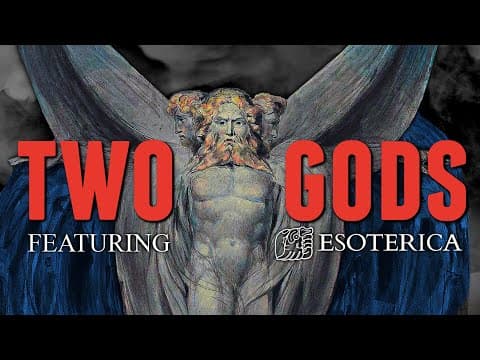
This blog post explores the connections between Jewish mysticism, particularly the Two Powers in Heaven heresy, and the development of early Christianity, focusing on the Apostle Paul's mystical experiences and their implications for the spread of Christianity beyond Jewish communities.
In a recent discussion with Dr. Justin Sledge, an academic specializing in Western esotericism, we delved into the intricate connections between Jewish mysticism and the origins of Christianity. This exploration centers on the Apostle Paul and his mystical experiences, particularly how they may have influenced the spread of Christianity beyond its Jewish roots.
Dr. Justin Sledge is an academic and the creator of the YouTube channel "Esoterica," where he explores topics related to Western esotericism, including magic, alchemy, and the occult. His work primarily focuses on the premodern world, and he aims to provide academic insights into these often misunderstood subjects.
Dr. Sledge's previous video, titled "How Ancient Apocalyptic Jewish Ascent Esotericism Laid the Foundations of Christianity," highlighted a significant aspect of Christian origins that is frequently overlooked: the influence of Jewish mystical traditions on early Christianity. He argues that the mystical practices prevalent in certain Jewish circles, particularly those associated with apocalypticism, played a crucial role in shaping Pauline Christianity.
One of the key motivations for Dr. Sledge's work is the observation that many discussions about the origins of Christianity fail to address the impact of Jewish mysticism. He posits that Paul, as a pivotal figure in early Christianity, had access to these mystical traditions, which informed his theological developments and missionary activities.
In 2 Corinthians 12:1-12, Paul recounts a peculiar experience where he claims to have been caught up to the third heaven. This account raises questions about the nature of his experience and its implications for his authority as an apostle. Dr. Sledge emphasizes that this mystical encounter is not merely a personal anecdote but a transformative moment that shaped Paul's understanding of his mission.
Paul's mystical experience is characterized by a shift from referring to himself in the third person to a direct claim of having experienced the divine. This rhetorical move serves to establish his authority, as he asserts that his insights come from a direct encounter with the resurrected Christ. This experience, according to Dr. Sledge, aligns with Jewish mystical traditions where practitioners sought to ascend to divine realms and gain esoteric knowledge.
Dr. Sledge introduces the concept of the Two Powers in Heaven heresy, which posits the existence of two divine figures: a higher God and a lesser divine being. This idea, which was controversial within Jewish thought, resonates with Paul's depiction of Christ as a semi-divine figure. The heresy suggests that Paul’s understanding of Jesus may have been influenced by these mystical traditions, allowing him to articulate a vision of Christianity that transcended traditional Jewish boundaries.
If Paul's mystical experiences were indeed rooted in Jewish mysticism, this would have profound implications for the development of Christianity. Dr. Sledge argues that Paul's vision of Jesus as a divine figure who opened the gates of heaven for all believers—Jew and Gentile alike—was revolutionary. It marked a significant departure from the Jewish apocalyptic movement, transforming Christianity into a broader, more inclusive faith.
Dr. Sledge suggests that Paul's theology reflects a synthesis of Jewish mystical thought and early Christian beliefs. For instance, the concept of transformation into a glorified body, as discussed in Paul's letters, parallels themes found in Jewish mystical literature. This connection indicates that Paul's understanding of salvation and resurrection was deeply intertwined with the mystical traditions of his time.
Furthermore, Dr. Sledge posits that Paul envisioned Jesus as having undergone a mystical journey similar to those described in Jewish mystical texts. This perspective democratizes access to the divine, suggesting that all believers can partake in the spiritual ascent that Jesus accomplished. In this way, Paul’s teachings extend the benefits of mystical experiences to the broader community of believers, breaking down barriers between social classes and ethnic groups.
The discussion also touches on the historical context in which Paul operated. Dr. Sledge notes that the early Christian movement was diverse, with various interpretations and practices coexisting. Paul's background as a well-educated Jew from Tarsus may have equipped him with the tools to engage with these mystical traditions, setting him apart from the more traditional Jewish followers of Jesus.
Interestingly, Dr. Sledge highlights that until the 1980s, many scholars overlooked the connections between Paul and Jewish mysticism due to a lack of access to relevant texts. The publication of Jewish mystical literature in the late 20th century has since opened new avenues for understanding the interplay between these traditions and the development of early Christianity.
The exploration of how Jewish mysticism, particularly the Two Powers in Heaven heresy, influenced the Apostle Paul and the early Christian movement reveals a complex tapestry of beliefs and practices. Dr. Sledge's insights challenge us to reconsider the origins of Christianity as a continuation of Jewish thought rather than a complete break. By acknowledging the mystical dimensions of Paul's experiences, we gain a deeper understanding of how Christianity evolved into a global faith that transcended its Jewish roots.



















