
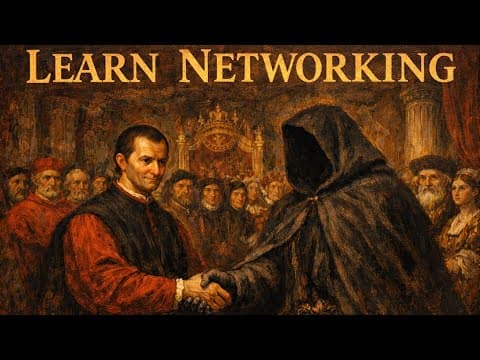
Connecting with powerful people requires strategy beyond mere admiration or requests. Drawing from Machiavelli’s 7 laws, this guide reveals how to demonstrate utility, observe and understand others, maintain loyalty, avoid overshadowing mentors, leverage gatekeepers, cultivate mystery, and project confidence to succeed in social climbing and influence in today’s corporate world.
Imagine you are at a grand business event or a high-profile party filled with the city’s wealthiest and most powerful individuals. Before you stands the person you admire most — the investor who could change the fate of your startup or the producer who could make you a star. You have only two minutes. Your heart races, palms sweat. What do you do?
Most people approach such moments by pleading, "Sir, I am a huge fan, please give me a chance," or by boasting about their achievements. If this is your plan, you have already lost before the game began. You have made yourself a supplicant, and the harsh truth is that powerful people despise those who come begging. They can sense neediness from afar.
This article dives deep into a realm where morality takes a backseat and winning is the only goal. We explore Niccolò Machiavelli’s seven laws, written over 500 years ago, which remain strikingly relevant in today’s modern corporate world.
In 16th century Florence, a city rife with deceit and power struggles, Machiavelli observed that the world does not operate on goodness but on meaning and utility. He famously wrote in The Prince that if you must choose between being loved or feared, choose fear — because love is given at convenience, but fear binds people to you.
Today, fear is not about intimidation but about the fear of losing respect or status. When you approach a powerful person begging, you signal that you have nothing to offer and everything to gain, making yourself a burden. Wealthy and busy people do not carry burdens; they shake them off.
Consider two men meeting a CEO in an elevator:
The CEO chases after Vikram because he solved a problem rather than added one. Powerful people see others as either useful or a waste of time.
Most people talk too much, trying to impress by boasting. Instead, be silent and observe. Understand the person’s insecurities, fears, and desires. Does the powerful individual crave money, fame, respect, or honest counsel?
For example, Andrew Carnegie, before becoming America’s richest man, noticed his boss’s stress over telegrams and decisions. Instead of asking for a raise, he learned the secret codes and helped decode urgent messages, becoming indispensable.
People trust those who resemble them in speech and demeanor. If an investor is calm and serious, do not laugh loudly or crack jokes. Adapt your tone and style to match theirs without mimicking them like a parrot.
Be a good listener. Powerful people are often lonely and appreciate someone who understands their world. When you mirror their behavior, they feel understood, and doors open.
In the corporate jungle, loyalty given freely is often undervalued. Always present yourself as a reward, not a disposable asset. Learn to say no respectfully and stand your ground with reasoned arguments.
This subtle rebellion earns respect. For instance, if your boss proposes an idea, instead of blind praise, point out potential risks tactfully and suggest improvements. This shows you are not a yes-man but a trusted advisor.
Every powerful person harbors ego and wants to feel like the smartest in the room. If you overshadow your boss or mentor, you risk being sidelined.
Even if your idea is brilliant, let them take credit. This builds their goodwill and makes them indebted to you. Being the one who makes others shine is a long-term strategy for climbing the ladder.
Most people try to reach the king directly but fail. Wise individuals build relationships with those around the powerful person — assistants, secretaries, drivers, or trusted advisors — who control access.
Treat these gatekeepers with respect and kindness. Understand their challenges and help them. Winning their favor opens doors that direct approaches cannot.
Do not be an open book. Reveal only what is necessary. When people are unsure about you, they think more about you, increasing your value.
Limit your availability. Do not answer every call or email immediately. Make people wait, as things that are awaited gain worth.
Walk into a room like you own it, even if you have nothing in your pocket. Confidence commands respect. Victor Lustig, a conman who sold the Eiffel Tower, succeeded because of his impeccable confidence and demeanor.
Networking with powerful people and influencing them is not luck; it is a science and an art. Everyone is selling something — time, skill, or soul. What you sell and how you sell it determines your value.
Stop complaining about arrogant rich people or a broken system. Understand the game and use it to your advantage. Machiavelli said those who try to be good everywhere end up destroyed among the bad. Be smart, strategic, and courageous.
Will you continue living a worn-out life, begging for chances, or will you adopt these laws and write your own destiny? History remembers only the winners, not their methods. Next time you meet a powerful person, do not be a fan; be a player.
Jai Hind!



















