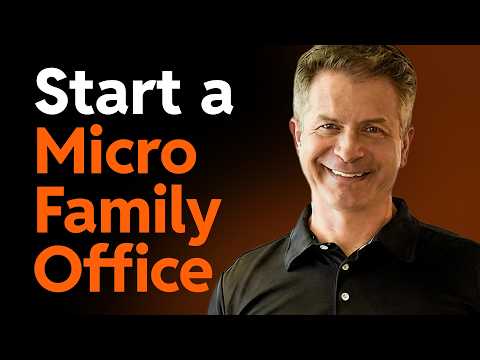
In 2025, many new millionaires face a financial services gap, being too wealthy for standard advisors but not wealthy enough for traditional family offices. This article explains how to build a micro family office—a scaled-down, systematic wealth management approach for those with $1 million to $30 million in assets. It covers the four-phase Wealth Ops Framework: Architect, Build, Run, and Succession, and highlights common mistakes to avoid.
In 2025, the United States saw the creation of 1,000 new millionaires every single day. However, crossing the million-dollar threshold often leads to what Christopher Nelson calls the "financial services desert." At this stage, individuals are too wealthy for cookie-cutter financial advisors but do not meet the $100 million minimum to access traditional family offices. This gap often results in analysis paralysis or poor investment decisions, potentially causing million-dollar mistakes.
Christopher Nelson, who experienced this firsthand in 2012, studied how ultra-wealthy families manage their money through family offices and developed the concept of a micro family office. Today, his micro family office generates over $200,000 annually in cash flow while the principal continues to grow.
This article outlines Nelson's four-phase process for building your own micro family office in 2026, enabling you to manage your wealth like a business.
Traditional family offices are private companies used by ultra-wealthy families (typically with $100 million or more) to manage investments, taxes, estate planning, and lifestyle needs such as property management and philanthropy. These offices require full-time teams and cost millions to operate.
A micro family office applies the same systematic approach but scales it down for professionals with $1 million to $30 million in net worth. It leverages fractional advisors, modern technology, and proven frameworks instead of a full-time staff.
Importantly, building a micro family office means you become the CEO of your own wealth. You establish systems, processes, and a team that works for you, putting you at the top of the organizational chart.
Nelson introduces the Wealth Ops Framework, consisting of four phases:
This phase involves creating the foundation of your wealth management strategy. It includes developing three critical documents:
Legacy Statement: Define your "why"—the purpose behind building your wealth. Whether it is financial independence, generational wealth, philanthropy, or other goals, clarity here guides all decisions.
Investment Thesis: Outline your strategy, including asset classes, risk tolerance, timeline, and allocation between growth, income, and capital preservation. Avoid random investments and focus on a cohesive plan.
Assessment: Conduct an honest inventory of your current financial situation, including assets, liabilities, cash flow, and tax basis. This baseline helps measure progress.
Turn your strategy into infrastructure by focusing on:
Legal Infrastructure: Set up proper entities such as trusts and holding companies for asset protection and tax efficiency. For some, a management company may also be necessary.
Team Building: Assemble fractional experts like certified tax planners, bookkeepers, and attorneys specializing in estate planning and asset protection. You manage these professionals as the CEO.
Systems and Technology: Implement a tech stack including a portfolio dashboard, accounting system, and document management system to organize and monitor your wealth efficiently.
Operate your micro family office with established rhythms:
Monthly: Review bookkeeping, cash flow, and portfolio performance.
Quarterly: Evaluate portfolio performance against your investment thesis, meet with tax planners, and assess new investment opportunities.
Annually: Set goals, review your legacy statement, update estate plans, and conduct tax projections.
This phase should require only 5 to 10 hours per week if the previous phases are done correctly.
Prepare your wealth business to be handed down:
Develop a comprehensive estate plan that evolves with your wealth.
Educate the next generation on your investment thesis and decision-making framework to prevent wealth loss.
Document all operations thoroughly so others can understand and manage the family office.
You should have between $1 million and $30 million in investable assets.
If you have less than $1 million, traditional personal finance strategies like maximizing 401(k) contributions and paying off high-interest debt may be more appropriate.
You must be willing to shift your mindset from an employee to a CEO managing a business, treating your portfolio as a business with revenue, expenses, assets, and liabilities.
Most financial advisors operate on a "fast food" business model, aiming to manage as much money as possible with minimal effort. They often provide the same diversified portfolio regardless of whether you have $500,000 or $5 million. They are not typically equipped to help with complex needs such as evaluating deals, divesting concentrated stock positions, building legal entities, or advanced tax strategies.
Overconcentration in One Stock: Holding 50% or more of your wealth in company equity is risky.
No Framework: Investing randomly without a systematic approach leads to losses.
Wrong Advisors: Most CPAs and advisors lack specialization in tax strategy or alternative investments.
Treating Taxes as an Annual Event: Strategic tax planning should be year-round.
Poor Investment Sizing: Allocating too much to a single deal is gambling, not investing.
Managing Millions Like a Savings Account: Shift from a drawdown portfolio to an evergreen portfolio model.
A clear strategy aligned with your life goals.
A diversified portfolio generating consistent income.
A team of experts reporting to you.
Efficient systems that do not consume your life.
Confidence in your decisions and wealth protection.
Building a micro family office allows you to manage your wealth like a business, providing structure, strategy, and control over your financial future. With the right mindset, framework, and team, you can grow and preserve your wealth across generations.
If you have between $1 million and $30 million in net worth and want to start managing your wealth like a business, consider attending a live workshop that guides you through building your micro family office foundation, including creating your legacy statement, investment thesis, and portfolio structure tailored to your goals.
Take control of your financial destiny by becoming the CEO of your wealth today.