
India aims to achieve 500 GW of non-fossil energy capacity by 2030, including solar, wind, hydro, nuclear, and biomass. Despite ambitious targets, the transition faces challenges such as financial stress in distribution companies, inadequate storage, policy delays, land conflicts, and uneven uptake of government schemes. The transition highlights the complexity of aligning multiple systems and the need for inclusive, just, and flexible governance.
India is undergoing one of the most ambitious and high-profile energy transitions in the world today — a shift towards clean energy. The country has declared a bold target to reach 500 gigawatts (GW) of non-fossil energy capacity by 2030. This target encompasses a diverse mix of renewable and clean energy sources including solar, wind, hydro, nuclear, and biomass.
These targets are not merely technical milestones; they symbolize India's leadership on the global climate stage, its commitment to sustainable development goals, and its imperative for energy security. Achieving these goals would mark a significant step in reducing carbon emissions and fostering a sustainable energy future.
Despite the ambitious goals, the reality on the ground reveals a complex picture. According to a special issue by Down To Earth on the green transition, there is a notable mismatch between installed capacity and actual generation capacity projected between 2024 and 2030. While installed capacity is increasingly dominated by renewables, coal still largely drives electricity generation, although its share is gradually decreasing.
Many projects announced as early as 2017-18 are still awaiting clearances or financial closure, indicating significant delays.
Financial Stress of Distribution Companies: Distribution companies (discoms) are under significant financial strain, making them reluctant to purchase variable renewable energy due to cost volatility and grid imbalance risks. This reluctance discourages large-scale renewable developers and delays power purchase agreements.
Inadequate Storage and Round-The-Clock (RTC) Solutions: Most solar power is generated during the day, but peak demand occurs in the evening. The lack of affordable and viable energy storage solutions makes providing continuous power a challenge.
Uncertain Policy Signals and Delays: Changing tender norms, slow approvals, and lack of coordination between central and state agencies create bottlenecks that stall project progress.
Land and Community Opposition: Large solar and wind parks often face conflicts over land acquisition and ecological concerns, leading to resistance from local communities.
Underutilized Government Schemes: Initiatives like PM SuryaR, PM Kusum, and the Production Linked Incentive (PLI) scheme for solar manufacturing have started well but suffer from uneven uptake, often benefiting urban or elite groups more than others.
India's clean energy transition is not hindered by a lack of ambition or innovation but by the complexity of aligning multiple systems — policy, infrastructure, finance, state capacity, and user trust. This complexity results in a bumpy pathway despite clear direction.
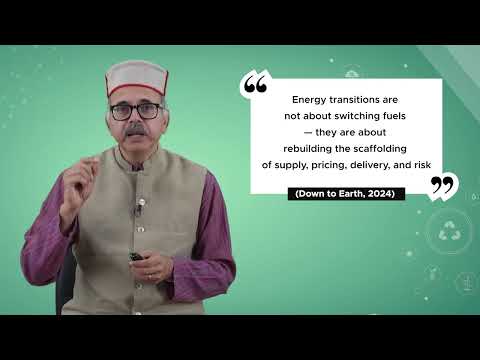
Energy transitions are not simply about switching fuels; they involve rebuilding the entire scaffolding of supply, pricing, delivery, and risk management. They occur within complex, multi-actor environments requiring strong institutions, smart grid systems, coordinated state and central actions, and models that serve small users alongside large utilities.
Sustainability transitions are systemic, long-term, and directional changes toward more just and sustainable futures. They are inherently messy, nonlinear, and shaped by multiple visions of what a better future entails. This plurality means there is no single path or script for transitions.
Different actors have varying definitions of sustainability — some emphasize green technology and growth, while others focus on equity, sufficiency, or ecological repair. Effective governance must therefore be open to learning, contestation, and diversity, prioritizing justice and inclusion alongside efficiency.
Transitions can inadvertently exclude certain groups. For example:
Hence, transitions must ask critical questions about who is included, who sets the direction, who bears the costs, and who benefits — a perspective often referred to as just transitions or transformative governance.
You do not need to be a policymaker or CEO to influence transitions. Students, citizens, entrepreneurs, and researchers all have roles to play. Actions can include:
Transitions require imagination, experimentation, and commitment at all levels.
Consider a sustainability challenge near you — air pollution, waste management, mobility, or water scarcity. Observe signs of transition and identify:
Document your reflections or create a visual map of what a transition could look like in your community.
India's journey toward a clean energy future offers valuable insights into the complexities and necessities of sustainability transitions worldwide. It underscores that while ambition and innovation are vital, the success of transitions depends equally on governance, inclusivity, coordination, and adaptability within complex socio-political landscapes.



















