
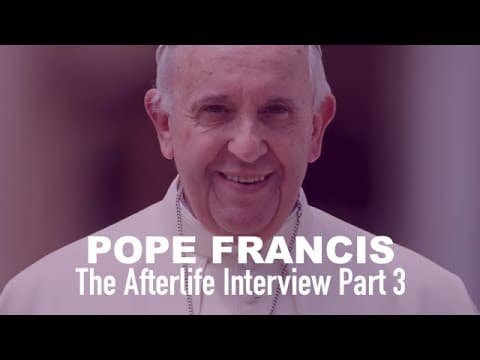
In this third part of the interview with Pope Francis, he discusses the new pope, the nature of God, the future of organized religion, and the challenges faced by the Catholic Church, including child abuse and the role of women. He emphasizes the importance of community in addressing corruption and shares his reflections on Jesus, sin, and the essence of spirituality.
In this enlightening session, Denise Ramon channels Pope Francis, offering profound insights into various topics concerning faith, spirituality, and the future of organized religion. This is the third part of a series that promises to deepen our understanding of these complex issues.
Denise Ramon, a medium, connects with Pope Francis through her son Eric, who has passed on. The conversation begins with a warm greeting from Eric, expressing excitement for the discussion ahead. The previous parts of this interview have laid a strong foundation, and viewers are encouraged to revisit them for context.
When asked about the new pope, Pope Leo, Francis expresses optimism. He notes that Leo is young and possesses a lot of stamina, which he believes will serve him well. Francis describes Leo as having worldly knowledge and awareness, suggesting that while some may not favor his progressive approach, he is well-equipped to address the challenges ahead.
Francis acknowledges the financial issues within the Vatican, stating that Leo will make more progress than he did, but emphasizes that it will require a collective effort to untangle the complexities of the situation. He humorously remarks that it takes a community to address such deep-rooted problems.
A significant question arises regarding the relationship between Jesus and God. Pope Francis explains that while Jesus was a human manifestation of God, they are not the same entity. He describes God as the collective essence of all existence, a self-aware energy that encompasses everything.
When discussing the future of organized religion, he predicts a gradual shift over the next few hundred years towards a more unified understanding of spirituality. He asserts that there is fundamentally one religion, which transcends the divisions we see today.
Reflecting on his life, Pope Francis shares that one of his most significant realizations was understanding that he was not God but a messenger of God. This revelation came to him during his papacy, highlighting the importance of recognizing the divine within everyone.
The conversation shifts to the Shroud of Turin and the historical narrative surrounding Jesus. Pope Francis suggests that there is truth to the idea that Jesus did not die in the traditional sense but rather underwent a form of staged death. He describes the crucifixion as exaggerated and theatrical, intended to instill fear and maintain control over the followers. This perspective challenges conventional Christian teachings about Jesus's sacrifice.
A pressing issue discussed is the abuse of children by priests. Pope Francis emphasizes the importance of transparency and dialogue in addressing this crisis. He clarifies that celibacy does not cause pedophilia and acknowledges that many priests are not celibate. He expresses deep shame over the harm caused to victims and advocates for open discussions to empower survivors and prevent future abuse.
When asked about the lack of recognition for women in the Catholic Church, Pope Francis explains that this exclusion was a means to disempower women, who possess significant spiritual power. He acknowledges the need for a shift in perspective regarding women's roles within the Church.
The discussion also touches on the concept of false prophets. Pope Francis notes that while individuals may claim prophetic status, true prophets do not instill fear. He encourages discernment in recognizing genuine spiritual guidance.
Reflecting on his time in the Vatican, Pope Francis shares that he often felt the presence of past popes and experienced a strong angelic energy. He acknowledges that while he sought enlightenment, he did not consider himself fully enlightened in the Buddhist sense.
The conversation concludes with a discussion on sin and the Ten Commandments. Pope Francis challenges the notion of original sin, asserting that individuals are not born sinful. He explains that the commandments were intended as guidance rather than strict rules, and emphasizes the importance of love and understanding in interpreting them.
This interview with Pope Francis offers a unique perspective on faith, spirituality, and the future of organized religion. His insights encourage a more compassionate and inclusive understanding of spirituality, urging individuals to recognize the divine within themselves and others. As we navigate the complexities of faith, these teachings remind us of the importance of community, love, and open dialogue in fostering a more harmonious world.



















