
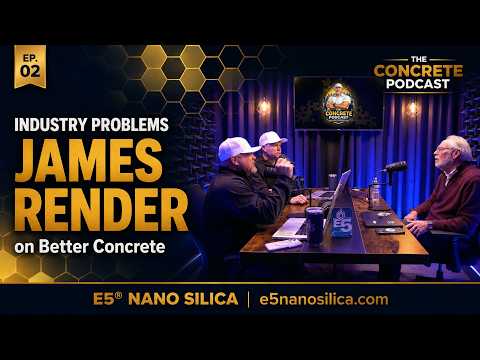
In this episode of the Concrete Podcast, James Render shares his extensive background in the concrete industry, emphasizing the critical role of aggregates in concrete mixes. He discusses misconceptions about concrete strength, the impact of admixtures, and the need for better communication between finishers and producers. Render advocates for a shift in industry standards to improve concrete quality and reduce costs, highlighting the importance of education and collaboration in overcoming long-
In the latest episode of the Concrete Podcast, hosts Joe Sherry and Joe Cookston welcome James Render, a seasoned expert in the concrete industry. With over four decades of experience, Render shares insights into the challenges faced by the industry and the critical role of aggregates in concrete production.
James Render's journey into the concrete industry began in his childhood, growing up in an aggregate family. His father, a civil engineer, introduced him to the world of construction and concrete from a young age. Render graduated from Auburn University in 1979 and started his career in Florida, working on significant projects like the Seminole Power Plant. Over the years, he transitioned through various roles, including working for W.R. Grace and Euclid Chemical, before establishing his consulting business.
One of the key points Render emphasizes is the importance of aggregate in concrete mixes. He explains that aggregates make up the highest percentage of concrete and significantly influence its properties. Despite this, many in the industry lack a deep understanding of aggregates and their impact on concrete performance.
Render addresses common misconceptions regarding aggregate gradation and cleanliness. He shares an experience where he successfully completed a large mass pour using aggregates that were technically out of specification, highlighting that total gradation is more critical than individual specifications. He stresses that the cleanliness and saturation of aggregates are vital for achieving optimal concrete performance.
Render points out that many finishers lack the resources and education to understand the nuances of aggregate selection and its effects on workability and finishability. He advocates for better communication between finishers and ready-mix producers to ensure that the right aggregates are used, ultimately leading to better concrete quality.
The discussion also touches on the role of admixtures in concrete production. Render notes that while admixtures can enhance concrete strength, they often do not address the finishability issues that finishers face on-site. He argues that the focus should shift from merely achieving higher strength to ensuring that concrete is workable and finishable.
Render critiques the current industry standards, suggesting that they have become too accommodating to aggregate suppliers at the expense of concrete quality. He explains that specifications have evolved to favor the use of gap-graded materials, complicating the mix design process. Render believes that a return to simpler mix designs using fewer aggregates could improve concrete performance.
The conversation also delves into the influence of regulations on the concrete industry. Render highlights how environmental regulations have led to changes in aggregate sourcing and processing, which can affect concrete quality. He urges the industry to adapt to these changes while maintaining a focus on performance.
Render expresses optimism about the future of concrete technology, particularly with the potential of new materials like nanosilica. He believes that innovations can significantly improve concrete performance and sustainability, but they require a shift in mindset within the industry.
As Render reflects on his career, he emphasizes the importance of leaving a positive legacy in the concrete industry. He aims to educate others and promote practices that enhance concrete quality and reduce environmental impact. Render's passion for improving the industry is evident as he encourages collaboration and knowledge sharing among all stakeholders.
In this engaging episode, James Render provides valuable insights into the concrete industry, highlighting the critical role of aggregates and the need for better communication and education. His extensive experience and forward-thinking approach offer a roadmap for overcoming the challenges faced by the industry today. As the concrete landscape continues to evolve, Render's commitment to innovation and quality will undoubtedly leave a lasting impact.



















